Aga meringues

Aga meringues with lemon curd

After I made lemon curd, I had five egg whites ready to make meringues.  They are a real treat and are delicious when made in the simmering or warming oven of the Aga. They don’t last long in our house, as the girls both love them, well they are balls of sugar so of course they love them.

You can either cook them in the simmering oven which takes about two hours or you can leave them overnight in the warming oven, which makes life very easy indeed.  I always make my pavlova in this way too.

For every egg white you will need 50g (2oz) caster sugar.  I always use golden caster sugar (which is less refined than white sugar) which gives them a lovely caramel hue.

5 egg whites
275g (10oz) caster sugar

Method

Line a baking tray with silicone paper.

Whisk the egg whites in a scrupulously clean bowl (I always wipe a cut lemon around the bowl to remove every bit of grease) until they form soft peaks when you lift up the whisk.  Add the sugar a teaspoonful at a time, whisking in each addition before adding the next.  The mixture will become stiff and glossy.

Place spoonfuls onto the baking sheet.  Place in the simmering oven of the Aga for about two hours and then place on top of a tea towel on top of the lid of the of the simmering plate to completely dry out.  Alternatively place in the warming oven overnight and they will be perfect in the morning.

Serve with whipped double cream, fruit, chocolate ganache or indeed lemon curd.

Aga meringues Read More »

Aga method lemon curd

Regular readers of this blog will know that I made lemon curd a few weeks ago. Very delicious it was too, but as I have an Aga it was quite hair-raising trying to save it from becoming lemon flavoured scrambled eggs.  This was because I was trying to save time and I was making it directly in a saucepan rather than in a bowl over a pan of simmering water.

When I went to judge Shropshire’s Tastiest Sausage, the event was held at an Aga shop and the great  thing about Aga shops is that everyone who works there is very knowledgeable about cooking on an Aga.  I spoke to the Sales Advisor, (who is a trained chef and offers one to one demonstrations on how to use an Aga), about my difficulties with my lemon curd and he suggested I read Richard Maggs’ The Complete Book of Aga Know-How as he has a method for making lemon curd in a jar in the simmering oven.  Now, I have cooked on an Aga since 1995 and so thought I knew quite a lot about the art of cooking on an Aga, but this book has been really useful in revealing tips about conserving and controlling heat that I hadn’t really thought about before.

The Aga method for making lemon curd worked really well.  It isn’t a recipe that is done and dusted in half an hour though, but it is one that means you can just leave it to do its thing and it is great if you are doing other things in the kitchen, so you can be there to add the ingredients and give the jar a shake from time to time.

I used Mary Berry’s recipe from The Aga Book, as I think it is a winner, with just the right amount of lemon.  This time though I used 5 egg yolks and made meringues with the egg whites to eat with the lemon curd.

For this recipe you need a sterile kilner or large jar.  If you are using a kilner jar remove the rubber seal whilst making the curd.  Richard Maggs suggests that you can store the curd in the same jar as you make it, but he obviously isn’t as messy as I am, so if you too are a messy cook I suggest sterilising one or two jars by washing them and rinsing them very well and then leaving them in the simmering oven (or a low oven at about 140°c) for twenty minutes.

100g (4oz) butter
225g (8oz) caster sugar
3 lemons, the finely grated rind and juice
5 egg yolks or 3 whole eggs, beaten

Method

Put the butter and the sugar in the jar, close the lid and place in the simmering oven for 30 minutes.  Take the jar out and add the rind and juice of the lemons.  Put the lid back on and give the jar a good shake.  Put it back into the simmering oven for another 30 minutes. By this time the sugar should have fully dissolved, if it hasn’t help it along by swirling the jar. Now you will need a small hand whisk or a fork and you will need to beat the eggs quickly into the mixture and continue to beat for one minute.  Put the lid back onto the jar and place back in the oven for a further 1 to 1¼ hours.  Give the curd a gentle shake and then leave to cool.  I was concerned that it wasn’t thick enough but it does thicken quite a  bit whilst cooling. When it is cool transfer to clean sterile jars if you feel the one you made it in is just too messy. Store in the fridge and eat within two weeks.

May 2014: I have been requested to link to Aga Living as this is a recipe from Mary Berry’s Aga Book.

Aga method lemon curd Read More »

Scotch egg

The inspiration for making scotch eggs for the first time a few weeks ago was my daughter asking me to buy one when we were in the supermarket.  I didn’t like the look of the orange breadcrumbs and I am fussy about sausages, so I determined to make my own.  Whilst we were making them my daughter insisted that her friend at school had four scotch eggs every lunchtime. Not quite believing this, I told her that no, her friend couldn’t have four scotch eggs, surely she must have only have one.  I had to ask said friend’s mother the next day, and in a way we were both right as she does have four scotch eggs, or at least one quartered, which does look like four.

Anyway, my first attempt was a great success, with Mr O C declaring that they were the best scotch eggs he had ever tasted, which I take as a very big compliment as his Mum used to make them a lot, and it’s always hard for a wife to compare with a mother!

I made them for tea again tonight, with chips and baked beans – now there is a healthy balanced diet for you.  My excuse is that it is winter and it is cold and it is dark – is that enough excuses? Anyway they are delicious.

As they are called scotch eggs I have gone as Scotch as I can and added oats to the breadcrumbs, but feel free to just use more breadcrumbs and leave out the oats.

6 eggs, plus 1 egg for the coating
600g sausagemeat
75g breadcrumbs
25g oats
plain flour

Method

Boil six of the eggs for six minutes.  You want them not quite hard-boiled. As soon as they are done, rinse under running cold water until completely cold to prevent the grey ring between the yolk and white, which will occur if you leave them to cool slowly.  Peel the shell of the eggs.

Divide the sausagemeat into 6 portions.  Take one portion into your hands and flatten into a rectangular shape that is large enough to wrap around an egg.  Take the egg and shape the sausagemeat around it making sure it is well sealed.  Repeat with the rest of the sausagemeat and eggs.

Sprinkle the plain flour quite thickly onto a plate.  Break the remaining egg into a bowl and beat well. Mix the breadcrumbs with the oats and put this mixture into another bowl.  You now need to dip each sausage-covered-egg into the flour until lightly covered, then dip into the egg and then lastly into the breadcrumbs until well covered.

I cook mine in the roasting oven of my Aga, which is equivalent to about 220°c (gas mark 7) placed on a baking tray drizzled with rapeseed oil.  I turn them a couple of times during the cooking and they take about 30 minutes to become golden brown all over. However they are normally deep fried in oil for about 6-8 minutes until golden brown and then drained on kitchen paper.

Get printable version

Scotch egg Read More »

Eccles cakes

My parents have an old friend who makes the most wonderful Eccles cakes.  Since I was little I have looked forward to the appearance of Joan’s old Roses tin with a batch of the most sublime cakes inside.  Her pastry is wonderful, so delicate, and that combined with the crunchy caramelised sugar topping and the sweet spicy bite of the currants and you are transported to cake heaven.

As a result of Joan’s marvellous cakes I have always been a bit put off from trying to make my own Eccles cakes in fear that they wouldn’t even come close to comparing to hers with her years of experience and pastry skills.

This weekend though I thought I would jump in at the deep-end and give it a go.  The girls were asking to make mince pies and the mincemeat from Christmas has all been used up.  I thought these may be an acceptable alternative.

I am really pleased with how they turned out and to my surprise they were nearly as good as Joan’s.  My youngest daughter, at three, surprised me with her pastry folding skills, some that she made were better than mine. It was a lovely way to spend an early Sunday morning.

I used Delia’s filling recipe as a basis for mine, but this did provide a little too much filling for the amount of pastry I had.  This isn’t too much of a problem though as I have just put the leftover filling in the fridge and I will make some more cakes with it, hopefully later today if I get a chance.  I have fetched it out of the fridge in anticipation.

Delia and Rachel Allen both use mixed peel, so you could substitute 50g (2oz) of the currants with mixed peel if you wanted to, but as I was trying to recreate Joan’s wonderful cakes and I have never discerned mixed peel in her filling I kept to a currants only filling.

500g (1lb 2oz) ready-made all-butter puff pastry (fully defrosted if frozen)

For the filling;

75g (3oz) butter
150g (5oz) soft brown sugar
200g (7oz) currants
1 tsp ground cinnamon
½ tsp freshly grated nutmeg
grated rind of 1 orange (or of 2 clementines)

For the glaze:

2 tbsp milk
2 tbsp demerara sugar

Method

To make the filling, melt the butter and add all the rest of the ingredients and mix well.  Leave to one side.

Roll the pastry to about 3 mm think and using a round cutter (mine is 8cm) cut out circles, re-rolling the dough as necessary.

Place a teaspoonful of filling on to each circle. Using a pastry brush, brush a little water all around the edge and fold one edge over to the other and seal well.  It should look like a little Cornish pasty at this stage.  Turn it over so that the seal is underneath and roll carefully with the rolling-pin to flatten it into a round.  Place on a baking sheet.  Repeat with all the other circles. Make three slashes in the top of each with a sharp knife and brush lightly with milk and sprinkle with the demerara sugar.

Bake in a preheated oven at 220°c (gas mark 7, roasting oven of the Aga) for 15 minutes or until golden brown.

Transfer to a wire rack to cool.

Get printable version

Eccles cakes Read More »

Chelsea buns

These were last weekend’s breakfast baking.  As I have said in earlier posts, the girls get me up early, so at the weekends I have used the opportunity to try baking or cooking something new.  Chelsea buns make a very decadent breakfast, but a very delicious one too.   The recipe again comes from Daniel Stevens’ Bread book (River Cottage Handbook No. 3).  I think next time I will bake them a bit longer than I did this time, as they were a little bit doughy, but I was very pleased with them.  They were lovely and buttery and were still good the next day.  All you need to accompany these is a good cup of tea.

For the buns:

550g (1lb 6 oz) strong white bread flour
50g (2oz) caster sugar
7g (1 sachet) of easy bake yeast
10g (½oz) salt
150 ml (¼ pint) milk
225g (9 oz) butter
1 egg

For the filling:

25g (1oz) melted butter
100g (4oz) caster sugar
200g  (8oz) currants

For the glaze:

50 ml (2 fl oz) milk
50g (2 oz) caster sugar

Method

You will need a deep sided 30cm square baking tin, buttered and coated with a sprinkling of caster sugar.

Place the butter and the milk into a pan over a gentle heat until the butter melts and the milk gets to hand hot. In a large bowl, mix the flour, caster sugar, salt and yeast and then add the egg and the butter and milk.  Using your hands mix to a sticky dough.  Knead the dough, as described in the spelt bread recipe until the dough is silky and smooth. Rinse the bowl clean and dry well and place the dough into this bowl, cover with clingfilm or a plastic bag and leave to double in size.

Place the dough onto a floured surface and roll to a rectangle measuring 60cm x 40cm or as close as you can get to this. Brush with the melted butter, leaving a 2 cm border along one of the longest edges.  Sprinkle the sugar all over the butter, top with the currants and then press them lightly into the dough.  Roll up the dough like a swiss roll, starting with the edge opposite to the one on which you left the 2 cm border. Brush the border with water and seal the edge well.  Slice into 9 pieces, place each piece into the tin, leaving space for expansion between each bun and flatten slightly with your hand.

Preheat the oven to 200°c (gas mark 6, bottom of the roasting oven of the Aga ) whilst you cover the tin with the clingfilm again and leave to prove for about 30 minutes until doubled in size again. Sprinkle with a little caster sugar and bake for about 20-25 minutes (mine needed 25 minutes but I was a bit too eager) until golden brown.

Just before the end of the cooking time warm the remaining caster sugar and the milk together in a pan over a gentle heat and when the buns come out of the oven, brush them immediately with this mixture to give them a delicious sticky glaze.  Leave to cool a little but make sure you enjoy at least one whilst it’s still warm from the oven.

Get printable version

Chelsea buns Read More »

Mocha cupcakes

I have to share these cakes with you.  In my haul of cookbooks, recently purchased, was Rachel Allen’s Bake and on page 266 of this book there is a picture of  20 cupcakes all decorated differently with an assortment of pink, blue and yellow icing, topped with an array of goodies including orange and lemon slices, jelly diamonds, silver balls, sugar flowers, sugar sprinkles and hundreds and thousands. My girls were both captivated by this picture.  When I asked which one was their favourite they showed their true selves.  The five-year who will more often than not choose a piece of fruit over a slice of cake chose one pretty pink cake with jelly diamonds on top.  The three-year old who will eat fruit only occasionally if really pushed decided that to pick just one favourite was an impossible task and decided that she would eat them all.  In fact she carried the book open at page 266 for the rest of that evening and most of the next morning.  I took the hint and asked her if she would like to make some and the answer was an emphatic ‘yes’.  You can see from the picture that she couldn’t wait for Mummy to take the photograph before diving in.

The recipe is Rachel Allen’s Mocha Cake from the same book and the topping is her cream cheese icing, with the addition of pink and purple colouring obviously optional.  We used all the decorations we had available in the house.  We saved five cakes to be decorated by the five-year old when she came home from school and my parents bought the contents of the decoration shelf of the local supermarket for her to use, so we have plenty of decorations in stock for the next batch!

The recipe made 24 fairy cakes, which is perhaps one too many even for my three-year old so we took them with us to school when we picked up her sister to share with her friends and they seem to have been well received by all involved.

For the cakes:

175g (6oz) self-raising flour
50g (2oz) cocoa powder
175g (6oz) soft brown sugar
175g (6oz) melted butter
4 eggs, separated
60 ml (2 floz) espresso
3 tbsp water

24 paper cake cases, two patty tins (otherwise it will make 12 muffin-sized cakes)

For the cream cheese icing:
75g (3oz) cream cheese, cold from the fridge
25g (1oz) butter, softened
75g (3oz) icing sugar

Method

In a large bowl, sift the flour and the cocoa together and stir in the sugar. Beat in the melted butter, egg yolks, the cooled espresso and water until well combined.

In a clean bowl whisk the egg whites until they form stiff peaks and then add this in three batches to the cake mixture, making sure it is all combined.

Spoon the mixture into the cake cases placed in the holes of the patty tin for support and bake in a preheated oven at 190°c (gas mark 5) for 10 minutes for fairy cake size and 15 minutes for muffin size. They should spring back when touched lightly with the tip of your finger when cooked. Leave to cool completely.

For the cream cheese icing, beat the softened butter until really soft and then beat in the cream cheese until well combined and smooth.  Sift the icing sugar into this mixture and mix well. Add flavourings (e.g.½ tsp vanilla extract) or food colouring as you please and decorate decadently or otherwise.

Get printable version

Mocha cupcakes Read More »

Spelt bread

It has been almost a week since my last post… where has the time gone?  Life has been busy, but I have been cooking (lots).  I just haven’t managed to sit down and write about it, so deciding which adventure I should share with you first was difficult.   I (or should I say we, as I don’t seem to do much cooking without the help (?) of little hands) have been cooking chelsea buns, brownies, chocolate cupcakes (decadently decorated, as only a three-year old can manage), pizza and cabbage and potato gratin.  However, this bread is something I am very proud of.

I think I am becoming a bit obsessed with bread.  Last year I blogged about my success with a loaf of white bread, after many years of trying.  Since then I have been practising and experimenting on a regular basis.  My aim is to become so good at making bread that I never have to buy a loaf again.

I won a £5 Amazon voucher over Christmas when I pulled a virtual cracker sent to me by Made Media (thank you Made) and so took the opportunity to buy a few more cookbooks (it was the perfect excuse!).  In my haul was the River Cottage Handbook No. 3 on Bread by Daniel Stevens and it is a great book; full of really good advice on how to achieve the perfect loaf.   There are lots of pictures accompanied by excellent descriptions to walk you through the process.

Since finding the Chocolate Log Blog I have been inspired by Choclette to use ingredients that I have never previously used, including spelt flour, hence the inspiration for this loaf.

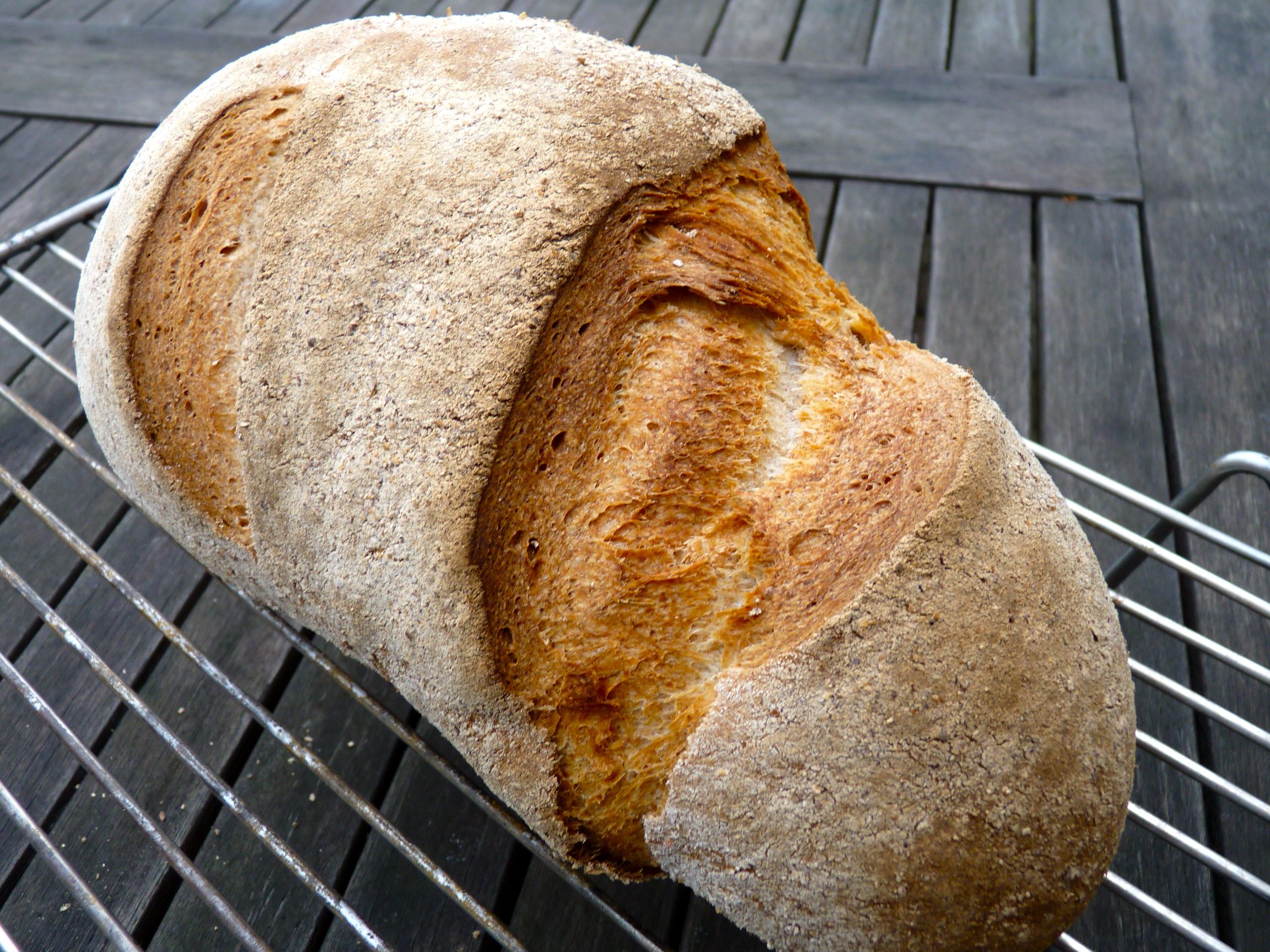
Spelt flour is low in gluten so I followed Daniel Stevens’ advice and mixed it with strong plain flour to make a lighter loaf than a pure spelt loaf would be. The spelt is deliciously nutty and just adds that extra bite to the bread, making it taste like homemade bread should. I was really pleased with the result and Mr OC complimented me on it, so it must have been good. The loaf rose a little unevenly, so there is room for improvement, but I am looking forward to continuing practising and moving towards the holy grail of homemade bread.

300g strong plain flour
200g spelt flour
1 sachet (7g) fast action yeast
10g salt
300ml warm water

Extra flour for sprinkling ( I used rye)

Method

Mix the flours in a large  bowl, add the salt and the yeast and pour in the warm water.  Mix with your hands to a soft dough.  There should be enough liquid to easily pick up all the flour in the bowl, but it shouldn’t be too sticky. Take the dough out of the bowl and on to a lightly floured surface (preferably wood).  If you are right-handed hold the dough with your left hand and using your right hand push half the dough away, trying to stretch it a full arm’s length away from you.  Then fold the stretched dough back on to that left in your left hand and repeat the kneading process making quarter turns of the dough every other stretch. (If you are left-handed then please substitute that hand for the right-hand).  Continue in this way for about ten minutes until the dough feels more elastic and you can’t really stretch it very far when you are kneading.  Fold the dough under so that it forms a ball.

Rinse the bowl clean, oil lightly, and place the dough into the bowl and cover with cling film or a large plastic bag. Leave in a warmish place, free of draught, until the dough doubles in size. The time this takes will depend on the temperature of the dough and of the room.

Preheat the oven to 250°c (gas mark 10) and Daniel Stevens’ tip is to buy a paving stone that fits into your oven to use as a baking stone and heat this in the oven and then use a bread peel (a flat board with a handle, like the one they use for placing pizzas into a pizza oven) to place your loaf directly onto this. I had a bit of a daft revelation in that I realised for the first time that if I placed the loaf directly on the floor of the roasting oven of my Aga I would achieve the same effect. I have always baked my bread on the tin that I have proved it on before and I think this new technique has helped.

Gently flatten the dough with your fingers, rather than punching the air out (again a change in technique for me) shaping it into a square.  Roll the dough much like you would a swiss roll and then using your fingers seal the join very well. Stretch the dough lengthwise until twice as long.  Fold over one-third to the middle and then fold the remaining third on to the top. Flatten again into a square with your fingers and roll up again as before, sealing well and then rolling gently into an evenly shaped baton loaf.  I then sprinkled mine generously with rye flour.  Leave to prove for about twenty minutes.  This time you want it to get bigger but not double in size again.

Slash the tops gently.  Place on to the baking stone and bake for ten minutes without looking.  Check the loaf and adjust the heat of the oven, if the crust is still pale then turn down to 200°c (gas mark 6), if it is already browning then 180°c (gas mark 4).  Cook for another 20-30 minutes. I left mine on the floor of the roasting oven of my Aga for thirty minutes.  It should sound hollow when knocked.

Leave to cool completely before slicing.

Spelt bread Read More »

Staffordshire Oatcakes

I have lived in the very beautiful county of Shropshire for much of my life apart from time spent in Cardiff for Uni and a brief sortie down to Margate and Broadstairs for work.  Now, Shropshire is right next door to Staffordshire but I have never before had a Staffordshire Oatcake.  Either this proves once and for all that I am a bumpkin or it shows how very regional, or local, food can be.   So I thought last weekend should be the weekend to change all that.

Recently, I have made a concerted effort to make at least one of the week-end breakfasts something a little bit special. Week-ends are even more precious now that my eldest has started school and we seem to see so much less of her.   As a result I have been experimenting with yeast – the girls normally bawl me out of bed around 6 am so I have plenty of time to get something prepared and then leave it to sit around for an hour or so and still get something on the breakfast table at about 8.30 am. I have made English muffins and crumpets so far (the crumpets need a bit more practice I think, hence not having blogged about them yet). The oatcakes though were a real success and I am regretting not having tried them much earlier in life.  They are much more substantial than a pancake with a really good wheaty flavour.  A friend tells me they are good with cheese melted on the top and I think that they would be really good as part of a Full English but on Sunday we had them with sweet toppings; maple syrup, lemon curd and marmalade ( as I had made marmalade on Saturday) and they were very good indeed.  I think the Staffordshire Oatcake is destined to be a regular feature of the week-end breakfast in our house from now on and my husband has requested that I make extra so that he can fill them for his lunch at work.

The batter makes 10 large oatcakes. I didn’t have any oatmeal in the house so I blitzed some porridge oats in my food processor for a few seconds to achieve a similar texture.

225g oatmeal (or porridge oats blitzed in a food processor)
225g wholemeal flour
1 tsp salt
1 sachet (7g) fast-action yeast
1 tsp sugar
450ml milk
450ml water

Method

Warm the water and milk gently until hand-hot.

Measure the dry ingredients into a large bowl and mix well.  Add the warm milk and water, mix well to combine.  To me it looked like it was going to be far too much liquid, but the oatmeal and flour soon absorb it so it really isn’t.

Cover the bowl with a cloth and leave in a warm place for an hour or so.  You will see that bubbles start to appear and froth.

Heat a large heavy based pan over a high heat and if your pan isn’t well seasoned brush with a smear of oil or butter and wipe off excess with a piece of kitchen towel.  When the pan is really hot, pour a ladleful of batter onto the pan, tipping the pan gently to make sure the mixture disperses into a good circle. Leave to cook for about two minutes until bubbles start to appear at the top and the mixture is beginning to cook on the top.  Flip the oatcake over using a fish slice and cook for a further minute until nicely browned on both sides. Keep this oatcake warm whilst you cook the rest of the batter in this way.

Serve warm with the savoury or sweet topping of your choice.

Get printable version

Staffordshire Oatcakes Read More »

The Shropshire Sizzle Off

When sausages on a stick become a serious affair!

It has been an exciting morning!  I have been part of the judging panel for Shropshire’s tastiest breakfast sausage and Shropshire’s tastiest speciality sausage today.  In all 21 sausages were sampled – that’s a fair few sausages.

Just before Christmas Heart of England Fine Foods (HEFF) asked for judges for this competition and regular readers of this blog will know that I love a good sausage and so couldn’t resist this invitation. There were six of us judging today and no doubt the other judges have a great deal more experience than me of this sort of thing.  The other judges were John Holden of Lucas Ingredients, a man with a wealth of experience of the meat trade; Jamie Yardley, chef and proprietor of The Boyne Arms in Burwarton; Richard Fletcher, chef and proprietor of The Pheasant Inn at Admaston; Eluned Watson of Shropshire Kitchen Magazine and Jenny Griffiths of the Aga Shop.  The competition was held at the Aga Shop in Ketley, Telford, which of course offered me a chance to gaze longingly at the lovely Aga pans and pretty much everything else in the shop. Oh to win the lottery!

The sausages were cooked in the roasting oven of the Aga – the best way to cook a sausage, of course.  They were then sliced and put into numbered dishes. We had to judge based on taste, internal appearance and texture.  It was really interesting to hear the comments of the other judges and whether they agreed with you, or not, about the merits of the particular sausage.  Judging the merits of a sausage is largely a matter of taste and what was good was that the judges tastes did seem to differ, some loved a particular sausage, others didn’t find it so appealing.

I found the breakfast sausages the most difficult to judge.  There were ten sausages in this category and there wasn’t a great deal of difference in a lot of them, some had been over seasoned, some weren’t quite the texture that you want in a sausage and one was judged by everyone to be ‘not a good sausage’. The winner of this category was Wenlock Edge Farm’s Proper Pork Sausage, which whilst it is indeed a good sausage, wasn’t my favourite, but it scored top marks with one of the judges and highly with the rest – as I say judging a sausage is a matter of taste. Highly commended was Shepley’s Pork Sausage and commended in this category was Maynard’s Farmhouse Pork Sausage.

The speciality sausage competition was very interesting as there were some very different sausages including Old Spot, Honey and Mustard Sausage; Pork, Cranberry and Sage; chilli flavoured sausages, beef sausage and venison sausage.  So this was definitely a matter of taste and depends on whether you like your sausage messed with or if you prefer a proper pork sausage.   There were some very tasty sausages in there and some which may be an acquired taste. Again Wenlock Farm won the day with their Wenlock Farm Pork, Bacon and Leek sausage.  Highly commended was Ludlow Food Centre’s Spanish Hot Spot ,which I will definitely stop off for next time I am passing as I think it would be a lovely sausage in a sausage hot-pot, (there’s a tongue twister for you, a Spanish Hot Spot Sausage Hot-pot).  Commended in this category was Moor Farm Shop’s Gloucester Old Spot Pork, Honey and Mustard sausage, which I thought was a very tasty sausage indeed if you want something a bit different.

So, well done to Wenlock Edge Farm, their winning sausages will now be judged at the Grand Final of the West Midland’s Sizzle Off at the Aga Shop in the Mailbox in Birmingham next Thursday.  I hope they make Shropshire proud.

I really enjoyed taking part in the judging process. I had a great morning and I now know which sausages I need to track down in the future.  However, I must admit that my local butcher is very hard to beat and had he entered his breakfast sausage that would have been the winner for me.

The Shropshire Sizzle Off Read More »

Bangers and mash with onion gravy

This was Thursday night’s tea. I am a big fan of sausages, so much so that I have volunteered my services to be a judge for Shropshire’s Tastiest Sausage this Tuesday.  I will tell you all about it when it’s all over. Back to our tea, bangers and mash is a classic combination and for very good reason, it’s the ultimate comfort food with fluffy mash, savoury sausages and rich onion gravy. I roast my sausages in the roasting oven of the Aga rather than grilling them, but really it’s the same thing. The onion gravy depends on getting the onions to caramelise and for this a slow cook over a gentle heat makes them meltingly tender and then a short blast over a medium heat finishes off the caramelisation.  Make sure you use the best quality sausages that you can afford, your local butchers are usually your best bet for a really good sausage.

Serves 2
4 medium-sized potatoes, peeled and cut into quarters
20g butter
6 sausages

For the onion gravy:
1 medium onion, peeled, cut in half and sliced thinly
25g (1oz)butter
2 tbsp plain flour
glug of Marsala or Madeira wine
(275 ml) ½ pint  hot stock ( I used chicken because that is what I had in the freezer)

Method

First start the gravy by putting 25g of butter to melt in a large pan and add the onion.  Cook the onions over a gentle heat until very soft and translucent. Turn the heat up and stir the onions in the pan until browned at the edges. Stir in the flour until it has been soaked up by the buttery onions and add the Marsala, stirring all the time.  Add the stock gradually, still stirring until the gravy is smooth.  Allow the gravy to simmer for five minutes or so until thickened.  Season with salt and pepper.

Whilst the onions are cooking, put the sausages onto a grill rack on a baking tray and place under a medium grill or into an oven preheated at 200°c and cook for 25-30 minutes until nicely browned all over.

Whilst the onions and sausages are cooking, place the potatoes in a saucepan and cover with cold water.  Bring up to a boil and simmer until a knife can be inserted easily all the way through. Drain and place the potatoes and 20g of butter back into the hot pan and allow the butter to melt over the potatoes. Mash with a potato masher or ricer until really smooth and creamy.

Serve the mash, sausages and gravy on warmed plates and enjoy.

Bangers and mash with onion gravy Read More »