Lemon curd

In honour of the fact that despite the snow and freezing temperatures of the last two weeks our five Black Rock chickens (there used to be six but that is another story – naughty Mr Fox!) are still laying 2-3 eggs each day I made some lemon curd today.  I was inspired by my mum who has made batches of this for my  dad in recent weeks as he has developed a particular fondness for it, as has my eldest daughter.  So I baked another loaf of brown soda bread so that we had something that we could slather it onto when she got home from school – and the combination was very good indeed.

I normally use Mary Berry’s recipe in her excellent The Aga Book, but today I followed Darina Allen’s in her Forgotten Skills of Cooking and I think maybe Mary Berry wins this one.  She cooks hers in a bain-marie  (a heat-proof bowl over a pan of hot water), whereas Darina Allen suggests doing it directly in a pan over a gentle heat and when you are using an Aga it can be difficult to get a gentle enough heat, even on the simmering plate, without being in danger of having lemon flavoured scrambled eggs.  I just managed to avoid this by taking it off the heat periodically and standing it on the cold granite worktop and giving it a good whisk with my balloon whisk.  Mary Berry’s technique takes longer but is less hair-raising.  However if you have a hob that you can easily control then Darina’s direct heat method will no doubt work very well.

Here is what I did, and it made enough to fill one ex-Bonne Maman conserve jar which previously had 370g of strawberry jam in it:

50g (2oz) butter
zest and juice of 2 unwaxed lemons
100g (40z) caster sugar
2 whole eggs plus 1 egg yolk, beaten

1 or 2 sterile jars (depending on size) – sterilise them by washing well, rinsing with hot water and then placing in a low oven for about 20 minutes. Make sure not to touch the rim or the inside once you have sterilised them.

Method

Either in a saucepan over a direct gentle heat or in a bowl over a pan of simmering water (depending on whether you can control your hob enough to give you a gentle heat) melt the butter.  Grate the zest of the lemons directly into the butter and squeeze in the juice, using a sieve to catch any stray pips. Add the caster  sugar and the beaten eggs. Stir all the while over the gentle heat until the mixture thickens and coats the back of the spoon.  If you are using the bain-marie (bowl over water) method this is likely to take about 25 minutes.

Pour the curd into the sterile jar(s) and seal when cool. Keep in the fridge and eat within two weeks.

It is good on fresh bread, warm scones or crumpets or you can make lemon curd tarts.  It is also good as the filling in a Victoria sponge.

Get printable version

Daisy in the snow

Lemon curd Read More »

Making our own pasta

I bought my husband a pasta machine for Christmas – well it was a bit of a hint!  Since then we have tried it out a few times.  I think it is something that needs practice to get perfect or maybe it’s just us.  It takes quite a while for the novice to do all the rolling that is needed and it is certainly easier to do if there are two fairly competent adults working together, rather than one frazzled adult and two small children. I need to work out the best way of storing the pasta between making it and cooking it so that I can make it in a more relaxed way, rather than trying to get it done quick because everyone is hungry.  I think the way I need to do this is to hang it over wooden spoon handles balanced carefully somewhere, but I am not sure that with the girls’ high level of interest in homemade pasta that it would stay balanced for long. So far we have placed the freshly made pasta on a plate sprinkled with semolina but this just hasn’t been effective enough, with the pasta inevitably clogging together.

What we all agree on though is that the pasta that we make tastes much more delicious than any dried pasta or indeed any fresh pasta that we have bought from the supermarket.  It has a much denser but somehow silkier texture and you can really taste the eggs.  The girls love making it, they stamp out their own choice of shapes, ranging from teddy bears to hearts (see the pic below).  They love eating it too, which is great because they are always asking for pasta and this is so much better for them than the dried variety and a good way to sneak some more eggs into their diet.

We just need more practice to perfect our technique and find a way of storing the pasta for that short amount of time between it being finished and it being cooked. If anyone has any advice that they can offer I would be very grateful.

The recipe I use is based on that in The River Cottage Family Cookbook which advises 1 whole egg per 100g (40z) flour or for a really egg-rich pasta use 2 egg yolks per 100g (4oz) flour.  However, because I use eggs from our own chickens they tend to vary in size and be a little smaller than supermarket bought eggs so I find that for two adult and two children portions I use 300g (12 oz) flour to three whole eggs plus one yolk. What you need to achieve is a slightly sticky dough that with kneading will become smooth and elastic.

Now, I am far from an expert pasta maker but this is what we have been doing to make some very delicious pasta, if not exactly as perfect as we hope it will become with a bit (or maybe a lot) more practice.

300g plain flour (or use ’00’ flour if you can get it)
3 whole eggs (or 6 egg yolks, see my note above)

Method

Place the flour into a bowl and make a hole in the centre.  Crack the eggs into the hole and using your hands mix the dough to combine, it should be very slightly sticky. Knead the dough for about seven minutes until it is smooth and elastic. Place the dough into a bowl and cover with a clean tea towel and leave to rest for fifteen minutes. If you are using a pasta machine put it on its widest setting and roll the dough through, fold and roll through again and repeat this a few times and then roll the dough through each setting until it is as thin as you want it.  You can now make it into whatever shape you crave.  You can, of course, roll the pasta using a rolling-pin, but it is quite hard work.

Put a large pan of salted water on to boil and when it is boiling plunge in the pasta.  If it is freshly made it will take a minute or two to cook, if you made it a few hours previously then it may take a little longer.  When it’s cooked, drain and dress with your favourite sauce.

The pasta shapes that the girls made

Making our own pasta Read More »

Darina Allen’s Brown Soda Bread

I was inspired by Kate the Bake to make French Onion Soup yesterday for our tea, but you can’t have soup without bread and I didn’t feel like trekking through the snow to the bakery.  Our very good neighbour, Dr. Bob, kindly bought me a brilliant book for Christmas, which I spent many hours over the holiday devouring – Darina Allen’s (2009) Forgotten Skills of Cooking (Kyle Cathie Limited).  I thoroughly recommend that you get yourself down to the bookshop or online immediately and get yourself a copy.   It has over 700 recipes covering all the basics and traditional recipes (stuffed goose neck anyone?) and it has sections on foraging,  keeping chickens, butchering, growing your own veg etc.  It’s a wonderful compendium which will be keeping me busy in the kitchen for years to come (so, thanks Dr Bob).

Anyway, to get back to the point, Darina has a recipe  for Beginner’s Brown Soda Bread and I have never made soda bread before so it sounded perfect.  It can also be prepared and baked in 1½ hours, so if you are a bit short of time and you need your bread quickly this is perfect.

I was very pleased with the results, the loaf rose beautifully with the soda and the crust was particularly delicious.  I was particularly pleased when my daughter came home from school and said “Oh wow, a homemade loaf, I love homemade bread” and asked for a slice with butter and Marmite.  That made me feel very glad I hadn’t trekked to the bakery.

If like me you haven’t made soda bread before I urge you to try it.

I didn’t have any buttermilk in the house so I took Darina’s advice and added two tablespoons of freshly squeezed lemon juice to 600ml (1 pint) of milk instead. The dough is extremely sticky but don’t be concerned by this as it is supposed to be like this, and if yours isn’t then you will need to add more liquid.

400g (14oz) wholemeal flour
75g (3oz) plain white flour, (Darina specifies unbleached if you can get it)
1 tsp salt, (Darina specifies dairy salt, which is finer and purer than normal salt, but I only have sea salt in the house so I used that)
1 level tsp bicarbonate of soda, sieved
1 egg
1 tbsp sunflower oil
1 teaspoon honey ( or treacle or soft brown sugar)
425ml (¾ pint) buttermilk  (or add 2 tbsp of lemon juice to 600 ml (1 pint) milk)

Method

Grease a loaf tin with vegetable oil. Preheat the oven to 200°c (gas mark 6).

Put the flours, salt and bicarbonate of soda into a bowl and mix well.  Make a well in the centre ready for the wet ingredients.

Whisk the egg and add it to the oil, honey (or treacle or sugar), and the buttermilk (or lemon juice/milk mixture).  Pour the wet ingredients into the dry ingredients and using your clean hands mix well.  The dough should be very sticky, Darina describes it as ‘soft and slightly sloppy’, if it’s not add more buttermilk. Pour into the loaf tin and bake for about 1 hour.  To test take it out of its tin and tap the bottom, if it’s cooked it will sound hollow.

Allow to cool before eating if you can manage it.

Get printable version

Darina Allen’s Brown Soda Bread Read More »

Carrot cake

This is my first attempt at carrot cake, I have often thought about making it but never got around to it.  My eldest daughter was asking for it on Sunday and we placated her with the bought version as we were out and about, but I thought I should give it a go and surprise her with it when I picked her up from school.  She was of course unimpressed, as five-year old’s are when the moment has passed for them.  Oh well, I was impressed with it and think it’s very tasty indeed, but I do hope someone will help me out with eating it or any good intentions for the New Year are straight out of the window.

My version is based on the recipe for Passion Cake in Best-kept Secrets of the Women’s Institute Cakes and Biscuits by Jill Brand, except I added cinnamon to the cake mix, used pecans instead of walnut and made my version of icing using a mix of icing sugar and soft light brown sugar.

I wonder why it used to be called Passion Cake?  You very rarely see it called that now, it sounds far more tempting than carrot cake.  In fact when I was young I wouldn’t entertain the idea of carrot cake – it sounded too weird. Then I braved it one day. I can still remember it, the trepidation, followed by the surprise that it was absolutely delicious and sweet.  I wasn’t expecting that!

For the cake:

225g (8oz) butter, softened
225g (8oz) soft light brown sugar
4 eggs, separated
finely grated zest and juice of 1 lemon
175g (6oz) wholemeal self-raising flour
1 tsp baking powder
½ tsp ground cinnamon
50g (2oz) ground almonds
115g (4oz) pecans, chopped chunkily
350g (12oz) carrots, peeled and grated

For the icing:

40g (1½oz) softened butter
40g (1½oz) cream cheese
25g (1oz) icing sugar
50g (2oz) soft light brown sugar
finely grated zest of 1 lemon
1 tsp lemon juice
pecan nuts to decorate

Method

Grease and line a 20 cm (8 inch) round cake tin and preheat the oven to 180°c (gas mark 4).

Whisk the softened butter and the sugar together until light and fluffy. Beat in the egg yolks and then add the lemon zest and juice. Sieve the flour, baking powder and cinnamon into the bowl, making sure you add all the bran left in the sieve when you have finished. Fold this gently into the mixture. Stir in the ground almonds and the pecan nuts.

In a very clean bowl and using very clean whisks beat the egg whites until stiff.  Add one-third of the egg white to the cake mix and mix in well. Add the carrots and mix in well.  Fold in the remaining egg white very carefully to keep as much air as possible.

Spoon into the prepared tin and level the top.  Bake on the middle shelf for 1 to 1½ hours until golden and firm to the touch.  I baked mine in the baking oven of my Aga and it took 1 hour and 10 minutes to cook, so do check at 1 hour and then keep checking.

Leave the cake to cool in the tin for ten minutes and then remove to a cake rack and leave to cool completely.

To make the icing, mix the butter and the cream cheese until really well combined.  Add the icing sugar and the soft light brown sugar and beat well until smooth, stir in the grated lemon zest and the lemon juice.

Spread on top of the cake and decorate with pecan nuts.

Take a big slice, make a cup of tea and enjoy!

Get printable version

Carrot cake Read More »

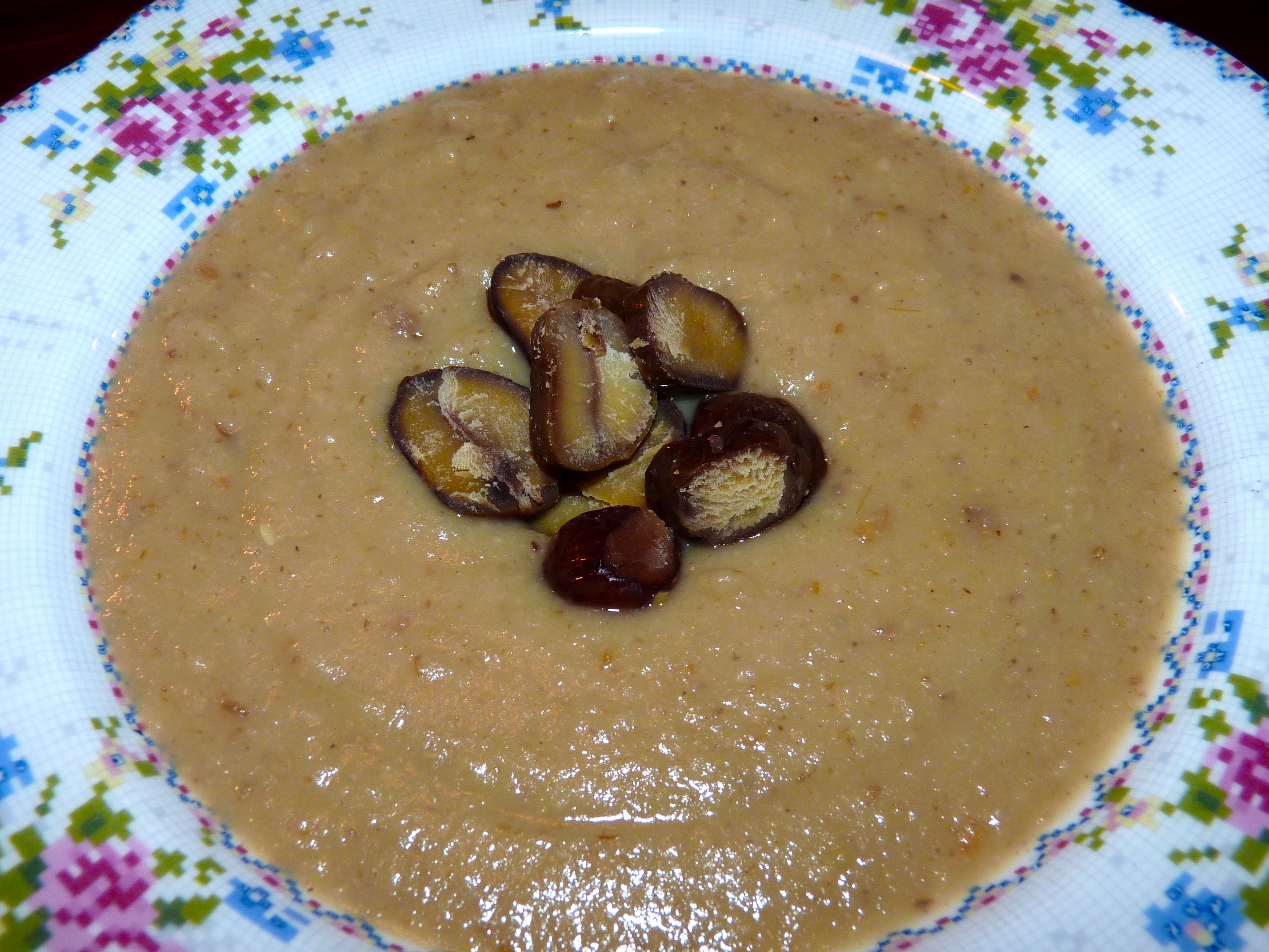
Parsnip, apple and chestnut soup

I was inspired to try my hand at this soup by a visit to a local café yesterday.  I was reading the Christmas menu that I had unfortunately missed, but on it was this soup and I knew I had to give it a go.  We have some parsnips left in the garden and my husband has complained that I haven’t been using them enough so I hacked my way through the frosty soil to get at them.

I have no idea whether it tastes like the soup served at the local café but this is delicious and a very comforting dish and you can taste all three of the main elements quite distinctly, although I may use a little less apple next time I make it as my version was a little too apple-y.  I have adjusted the recipe below accordingly so I hope yours won’t be.

1 large parsnip (about 300g), peeled and chopped into chunks
1 small Bramley apple (or half a large apple), peeled, cored and chopped into chunks
1 onion, diced
1 small potato, peeled and cut into chunks
100g roasted chestnuts, plus a few extra for slicing to serve on top of the soup (I use the vacuum packed variety for ease)
20g butter and a drop of olive oil
570 ml (1 pint) chicken or vegetable stock
1 tbsp cumin seed
salt & pepper to taste

Method
Melt the butter with the drop of olive oil in a large pan over a medium heat and add the onion and cook for a few minutes, being careful not to allow the onion to brown.  Add the parsnip, potato and apple and cook for a few minutes more.  Add the cumin seeds and stir to combine and continue to cook for a few minutes. Season with a little salt. Add the chestnuts and the stock and bring to a simmer and cover the pan with a lid or foil.  Cook over a gentle heat for 20 minutes until the vegetables are tender.  If you are using an Aga, place the pan in the simmering oven for this amount of time. Check the seasoning and adjust to taste with salt and pepper.

Blend the soup either with a hand blender or in a blender or processor until smooth.  Serve in warmed bowls, sprinkled with thinly sliced roasted chestnuts.

Get printable version

Parsnip, apple and chestnut soup Read More »

Duck terrine

I had some roast wild duck left over just before Christmas and so I came up with this terrine as a tasty way of using it up.  My mum gave me some mushrooms as she had picked up a bargain box from the market so the middle layer is the mushroom mixture I use for Beef Wellington with a dash of double cream and roasted chestnuts added.  The whole thing was a winning combination with a good mix of texture and taste.

You could use leftover chicken, pheasant or indeed any fowl to make this terrine.

200g duck (already cooked and stripped off the bones)
6 sausages
6 rashers middle bacon
150g mushrooms, wiped and chopped chunkily
100g roasted chestnuts ( I used the vacuum packed variety), chopped chunkily
25g butter
1 onion, chopped finely
3 tbsp double cream
2 tbsp Marsala or Madeira wine
2 tbsp chopped parsley

Method

Line a loaf tin with the rashers of bacon, overlapping them and leaving a good overhang so that they will stretch over the top of the terrine at the end. I alternated using the back part of bacon with the rasher part which helped fill the gaps better.

Melt the butter in a large pan over a medium heat and add the onion and fry until golden, remove to a plate.  Add the mushrooms to the same pan and cook until golden, add the onions back to the pan and add the chestnuts.  Add the Marsala and reduce by a half and then stir in the cream and bubble for a moment and then take this off the heat. Add the chopped parsley and stir to combine.

Take the skin off the sausages.

Place the duck meat into a food processor with half the sausage meat (i.e. the meat from 3 of the sausages) and pulse until fairly smooth and combined.

Place half the duck mixture into the bottom of the terrine and spread out evenly.  Next add the mushroom mixture and spread evenly.  On top of this layer the remaining sausage meat and then the final layer of duck mixture. Wrap the overhanging bacon rashers over the top of the terrine until it is completely covered.  Cover tightly with foil and bake in a preheated oven at 180°c (gas mark 4 or the baking oven of the Aga) for 1 hour or possibly up to 1½ hours.  You will know when it is cooked as it begins to shrink away from the sides of the tin.  Leave the terrine in the tin to settle and then turn out when completely cold. This is good made the day before you want to eat it to allow the flavours to develop.  Serve in slices.

Get printable version

Duck terrine Read More »

Clementines in sugar syrup

I made this clementine salad for pudding on my Mum’s birthday and served it with the Victoria Sandwich, which was a very good combination – it was reminiscent of trifle.  It is equally good served on its own or with a splash of cream.  If you want to jazz it up further a splash of orange liqueur in the sugar syrup would be very good indeed.

It is very easy to make and studded with the pomegranate seeds it is jewel-like in appearance.

5 clementines
½ pomegranate
100g caster sugar
50ml water

Method

Using a sharp knife cut the peel and pith off four of the clementines and then slice the segments out of the skin so you have just the flesh and none of the skin.  If you can do this over the serving bowl that will mean that any escaping juice will be caught.  Place the clementine flesh in a glass serving bowl.  Squeeze the juice out of the remaining clementine and pour over the clementine flesh. Hold the half of the pomegranate over the serving bowl and using a spoon bash the skin of the pomegranate so that the seeds scatter into the bowl.

Place the sugar in a small saucepan and pour over the water.  Place over a gentle heat until the sugar has completely dissolved.  Turn the heat up slightly and let the syrup boil for about two minutes until it develops a golden colour. Pour the sugar syrup over the clementines (if you wanted to add a splash of orange liqueur this would be the time to do it) and then chill for a few hours before serving.

Get printable version

Clementines in sugar syrup Read More »

Victoria sandwich – the all-in-one method

It is my Mum’s birthday, which of course means a cake. My choice would, of course, be chocolate, but it wouldn’t be my mum’s so a Victoria sandwich fits the bill nicely.

This one is very easy and quick to make. You can have the cake in the oven in minutes.

I have taken the advice of Hugh Fearnley Whittingstall and Fizz Carr in their excellent Family Cookbook and weighed the eggs in their shell and then used the same weight of butter, sugar and flour. I have not followed their creaming method though which calls for the butter and sugar to be beaten first and then the eggs incorporated and then the flour folded in.  Instead, I have used the all-in-one method as used by Mary Berry in her The Aga Book. For the all-in-one method to be a success it is crucial that the butter is soft, so you must remember to bring it out of the fridge a couple of hours before you want to make the cake. It is also important to add a teaspoon of baking powder to the self-raising flour as you won’t be beating in as much air with this method.

It is delicious with raspberry jam and softly whipped cream but you could sandwich it just with the jam of your choice or lemon curd or even a buttercream.

4 eggs – weigh them in their shells and then use the same weight for the sugar, flour and butter.  (My four eggs from my lovely hens weighed exactly 200 grams so I used 200g butter, 200g sugar and 200g of self-raising flour for the cake above).
soft butter
caster sugar
self-raising flour
1 tsp baking powder
1 tsp vanilla extract
a splash of milk

The jam of your choice
150ml double cream, softly whipped
1 tsp icing sugar to dust the top of the cake

Method

Preheat the oven to 180°c (gas mark 4).  Grease 2 sandwich tins with a smear of butter and line the bases with greaseproof paper.

Put the butter, sugar and eggs in a large bowl and sieve the flour and baking powder in. Add the vanilla extract and a splash of milk.  Using an electric whisk on medium speed whisk the mixture until all combined.  Divide the mixture between the two tins and spread evenly.

Place in the middle of the oven for 25 minutes until golden and springs back when touched lightly.

Turn out onto a cake rack and allow to cool completely.

Spread one of the cakes with the jam and then the cream (or the filling of your choice) and then place the other half of the cake on top.  Dust lightly with icing sugar.

Get printable version

Victoria sandwich – the all-in-one method Read More »

Swaddled toad in the hole

It’s cold outside so a toad in the hole needs a blanket to keep him cosy. The sausages are wrapped in streaky bacon in my toad in the hole to make the dish even more substantial and warming on a cold, dark night.

We had this for tea last night with peas and onion gravy and it was very good indeed.

You can also use pancetta or parma ham to wrap the sausages.  The batter is the one I use for my yorkshire puddings.

8 sausages
4 rashers of streaky bacon
100g (4oz) plain flour
2 eggs
225ml (8 fl oz) milk
a little lard or oil

Method

Cut each bacon rashers in half and stretch slightly.  Wrap a rasher around each sausage.  Place into a large rectangle baking dish (mine measures 32cm x 23cm) with the lard or oil and place in a preheated oven at 200°c (gas mark 6) for five minutes so that the oil gets hot.

In the meantime measure the flour into a bowl or large jug, make a well in the centre and add the eggs and a little of the milk and whisk to a smooth batter, add the rest of the milk and mix well.  The batter should be the consistency of single cream.  You won’t need salt if you are using bacon but if you aren’t using bacon you may need a pinch of salt in the batter.

Fetch the sausages out of the oven and pour the batter evenly over.  Place back into the oven and cook for 25-30 minutes until everything is golden.

Get printable version

Swaddled toad in the hole Read More »

Jam or lemon curd tarts

It’s the simple things in life which bring us most pleasure! This is definitely the case when it comes to enjoying a jam and a lemon curd tart with a cup of tea. These tarts are very easy to make and taste delicious, especially if they are still a little warm from the oven.

We were making mince pies and I had some pastry left and my mum had given us a jar of her very lovely homemade lemon curd so these were begging to be made.  My eldest daughter loves lemon curd and my youngest loves jam, so I made some of each.

You can make the pastry with 50g of butter or you can use half butter and half lard, it will depend on what you have in the fridge or indeed whether you are catering for vegetarians. I used half lard and half butter this week as we always have lard in the fridge in the winter ready for making the birds some seed cake.

You can use whichever jam is your favourite.

This will make 12 tarts.

25 g (1oz) lard or vegetable fat
25g (1oz) butter
100g (40z) plain flour
cold water to mix ( about 2 tablespoons probably)

12 teaspoons of the jam or curd of your choice ( I used 6 teaspoons of raspberry jam and 6 teaspoons of lemon curd to make 6 tarts of each variety)

Method

I always make my pastry in my food processor because it means less handling and so a flakier pastry. Dice the butter and lard and place in the bowl of the food processor, add the flour and pulse the processor until the mixture resembles breadcrumbs.  Add the cold water and pulse again until a dough just begins to form.  Take the dough out of the machine and shape into a flattened ball.  Wrap in a food bag or clingfilm and place in the fridge to chill for 20 mins.  Roll out on a floured worktop and stamp out rounds using a 7cm fluted cutter.  Press each round into a hole of a patty tin. Place a teaspoon of jam in each tart.  Don’t overfill as the jam will spread as it cooks.

Place in a preheated oven at 200°c (gas mark 6) for 15 -20 minutes until the pastry is golden brown.  Leave to cool a little before placing on a wire tray.

The tarts ready for the oven

Jam or lemon curd tarts Read More »