theordinarycook

The Ordinary Cook loves to cook. If I am not cooking or baking then the chances are I am thinking about cooking and baking. I love sharing recipes and ideas and my website is my space to do this.

Savoury bread pudding

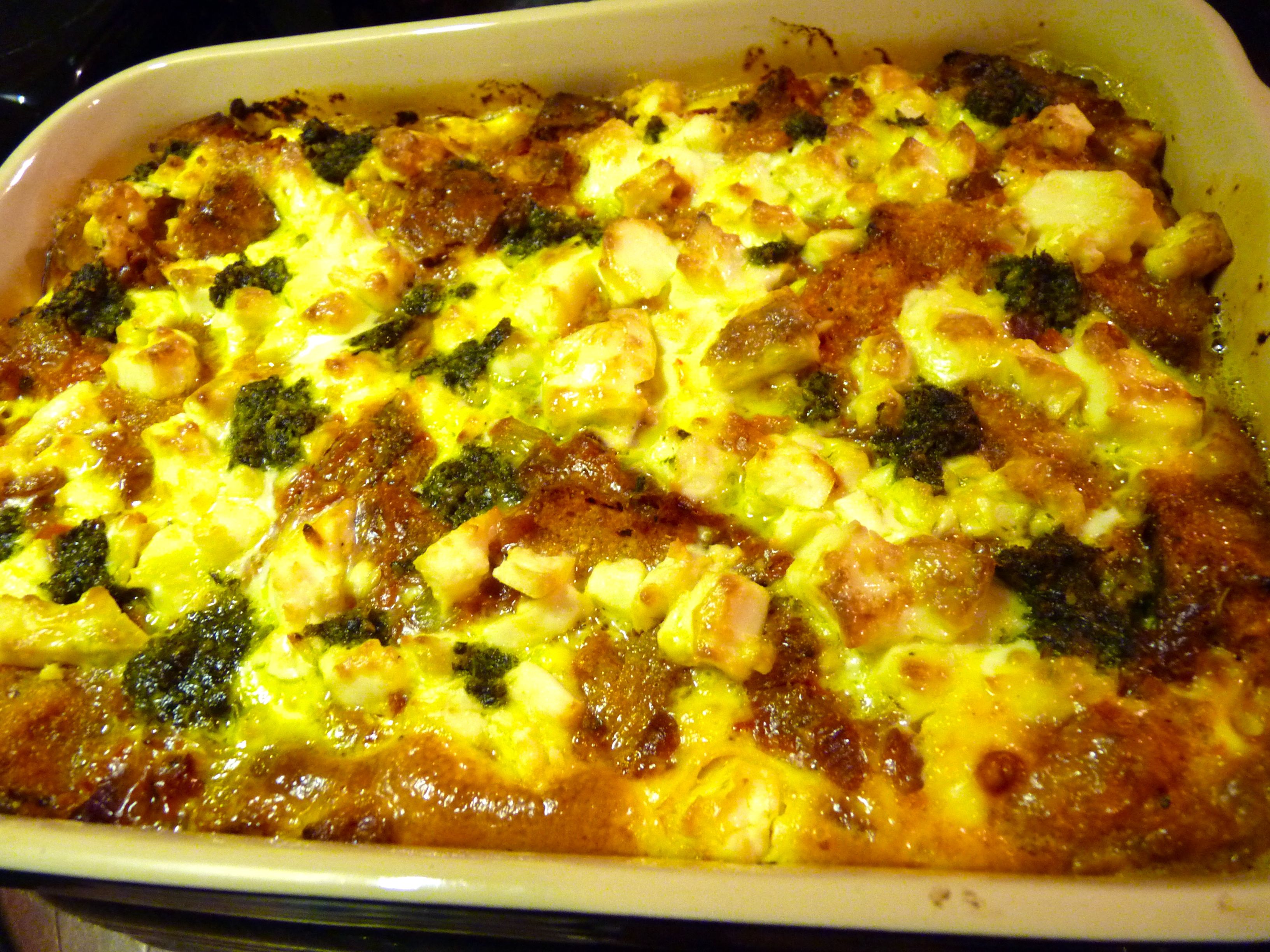
Last night’s tea was completely inspired by Nancy over at Good Food Matters.  She made the most delicious Tomato and Mozzarella Strata, all bubbling and pillowy.  Well, last night I had the remains of a cooked chicken in the fridge and half a loaf of bread on the side.  So I adapted Nancy’s Strata by adding the chicken chopped small as the first layer, cooking chorizo in with the tomato sauce and used feta instead of mozzarella.  A very fine dish indeed.  Pop over to Nancy’s to find out how to make your own savoury bread pudding.

This was the dish before it was baked in the oven for forty minutes.

Before going into the oven

You can watch me make a similar version in this video

Savoury bread pudding Read More »

Easter biscuits

The official name for these tasty morsels is Easter biscuits, but in this house they are called Animal biscuits and they should actually be called Poorly biscuits.  These are the ones that I am asked to make if either of the girls is feeling a bit off colour. This is because I made them once for the little one when nothing else would tempt her to eat but these did the trick.  Ever since at the slightest sign of illness Animal biscuits have to be made. Well, the little one has a cold.  Nothing too serious, but I am sure the other children at pre-school would prefer not to have it, so yesterday there was the usual request to make Animal biscuits.

I have recipes for these biscuits in two of my books; Jill Brand’s The Best Kept Secrets of the Women’s Institute, Cakes and Biscuits and Louise Walker’s The Traditional Aga Party Book. I normally make them from the latter, but yesterday I made them from Jill Brand’s book, in which she suggests removing them from the oven half way through cooking, brushing them with egg white and dusting with caster sugar and then cooking them for the rest of the time.  Feel free to do this, but I can’t really tell the difference between this and Louise Walker’s advice to dust them with caster sugar as soon as they come out of the oven.  As the first way is a faff, I would suggest following Louise Walker on this point.

Louise Walker explains that currants were once a prized possession and so these biscuits were made for special occasions and were often handed out to children after church on Easter Sunday.

This recipe combines both of the above recipes to make them mine.

Makes about 20-24 biscuits depending on the size of your cutter.

100g (4oz) softened butter
75g (3oz) caster sugar
1 egg yolk (feel free to use the egg white as described above)
200g (8oz) plain flour
½ tsp mixed spice
½ tsp ground cinnamon
75g (3oz) currants
splash of milk
caster sugar to sprinkle on the cooked biscuits

Method

Cream together the butter and sugar in a large bowl until light and fluffy.  Beat in the egg yolk.  Add the flour, spices and currants and mix with a spoon. You will probably need a splash of milk to get it to a soft dough that will roll out.

Place the ball of dough on a lightly floured surface and roll out until it’s about 5mm thick.  Using any shape cookie cutter that you like (the tradition is for rounds) cut out shapes, re-rolling the dough when you need to, and place onto a baking tray (you will need two baking sheets). Place the trays in a preheated oven at 200°c, gas mark 6 or near the bottom of the roasting oven of the Aga for 10-15 minutes until they are lightly golden.  Sprinkle liberally with caster sugar whilst still warm.  Place onto wire racks to cool.  Eat and feel better.

Easter biscuits Read More »

Croissants and pain au chocolat

I have wanted to make croissants for ages but it seemed like it might be too much mither. Well, last night I decided to take the bull by the horns and just give it a go. It was quite a bit of work, but actually not as much as I was expecting and the results are more than worth the effort.  You just need to do a bit of preparation the night before, leave the dough to rest in the fridge and then finish off in the morning.

In fact I was quite excited this morning about it all and I was really pleased when they turned out to taste just as good as I hoped. I made some croissants and some pain au chocolat – what a treat!

I used Rachel Allen’s recipe from her book Bake (ISBN 13 978 0 00 725970 0) which if I could have found a link online I would have just pointed you in that direction as I am dreading writing all this down, but here goes. (Bake is well worth seeking out, I have used it a lot since I bought it and Rachel Allen’s recipes always work).

I got some early morning help from my two girls this morning so they appear in some of the pictures.

Makes 18 croissants

275ml milk
25g sugar
1 sachet of easy bake fast acting yeast
450g Strong white bread flour
275g salted butter, softened (but not too soft)

For the egg wash:
1 egg beaten with 1 tsp milk

If you want to make pain au chocolat you will need a dessert spoonful of chopped chocolate for each pain au chocolat that you wish to make. I made 12 croissants and 6 pain au chocolat.

If you want them for breakfast then I suggest you start the night before with the following steps.

Heat the milk until warm. Rachel Allen suggests rubbing in 50g of the butter into the flour but I just put it into the warm milk so that it half melted.  Place the flour, sugar and yeast in a large bowl. Add the milk and butter and bring the mixture into a soft dough.  I used my KitchenAid freestanding mixer with the dough hook attached and mixed it for 5 minutes.  If you haven’t got a freestanding mixer then this doughy is sticky and you will need lightly floured hands to knead it by hand for ten minutes until it is soft and elastic. Make it into a ball and place back in the bowl.  Cover with a large plastic bag or clean tea towel.  Rachel Allen suggests putting it in the fridge for two hours but I just left it in a cool place in the kitchen.

After two hours, place the remaining butter between two large sheets of clingfilm and, using a rolling pin, beat and roll it until it is about 8mm thick and measures roughly 10cm x 20cm.

Take the dough out of the bowl and place onto a lightly floured surface and roll it into a rectangle measuring 20 x 40 cm. Place the butter onto one half of the pastry.

Fold the other side of the pastry over onto the butter.

Roll the dough out until it again measures about 20 x 40cm.  Fold one third over, then fold that over and then fold again. Cover the dough with the large plastic bag and place in the fridge to rest for 30 minutes.

Take the dough out of the fridge and place it with the open ends facing towards you. Roll out the pastry again to a similar size as before, then fold in three again.  Place the dough back into the bag and put in the fridge overnight.

In the morning it will look something like this, having begun to rise:

So the next morning, take the dough and roll out again into a rectangle and then fold over three times again.

Roll out the pastry until it is about ½ cm thick and measures about 35cm x 55cm.  This takes quite a bit of effort as the dough is cold.

Now I wanted to make some pain au chocolat and some croissants, so I sliced off one third of the dough and then cut this into six pieces.  On each piece I placed a spoonful of chopped good quality chocolate and then rolled up firmly like a swiss roll.

For the croissants I cut the remaining dough in half lengthways and then into thirds widthways and then each rectangle into a triangle. This resulted in 12 triangles.  Starting from the widest edge roll the pastry tightly, then tuck the tip underneath and shape into a crescent shape.

Place on a baking sheet (you will need two) leaving space for them to rise and brush gently with egg wash.

Leave to rise in a warm place for 30-40 minutes.  I put mine on top of two tea cloths on the warming plate of my Aga.

When they have risen, brush gently with egg wash again and then place in a preheated oven at 220°c, gas mark 7, or the roasting oven of the Aga for 10 minutes and then turn the oven down to 180°c, gas mark 4, or move them to the baking oven of the Aga for another 10 minutes until golden brown all over.  Place them on a wire rack to cool just a little.  They are best eaten warm, with lashings of butter and jam (or lemon curd, or marmalade) on the croissants.

Croissants and pain au chocolat Read More »

Chocolate almond cookies

My four year old and I have just made these.  A very good friday afternoon treat.  They are chewy and distinctly almondy and definitely chocolatey.  I think next time I make them I might add a few drops of almond extract instead of the vanilla extract to really draw out the almond taste.

Makes about 10-12, depending on how generous you are with the spoonfuls.

125g butter
50g muscovado sugar
50g caster sugar
1 egg
1 tsp vanilla extract
50g wholemeal spelt flour
80g ground almonds
20g cocoa
½ tsp baking powder

40g good quality chocolate, melted, to drizzle over the top

Method

Melt the butter in a small pan.  Place the sugars in a bowl.  Pour the melted butter over the sugars and mix well. Add the egg and the vanilla extract and mix again.  Tip in the flour, almonds, cocoa and baking powder and mix again.  It will be quite sloppy.  Place spoonfuls onto greased baking sheets.  These cookies spread a lot so leave plenty of space between them.  Bake in a preheated oven at 180°c, gas mark 4 for 8-10 minutes.  Leave on the tin for a few minutes to harden and then remove to a wire rack to cool completely.  Drizzle with the melted chocolate.

Chocolate almond cookies Read More »

Chocolate Marmalade Cake

This is my submission for this month’s We Should Cocoa Challenge.  This month it is Chele’s turn again to host the challenge and she came up with the idea of using leftovers or surplus stock.  This is a great idea post-Christmas, but unfortunately because we are so greedy in this household we had no leftovers to speak of. I have been racking my brain for a solution and of course, when I glanced again at the 10 jars (well 9 now, I did mention that we are greedy) of marmalade that are sitting on a tray on top of the hob waiting for me to decide where to keep them, inspiration struck.

One of my favourite cookbooks on my shelf is The Dairy Book of Family Cookery, not necessarily for the recipes, although I have cooked from it many a time, but because of the nostalgia it has for me.  It was written in 1983 and my mum bought it from the milkman.  It was a book I grew up with and used a lot when I was a teenager.  I remembered this morning that I cooked a Marmalade cake with a crunchy cornflake topping when I was about fourteen (only a few years ago!).  I thought I would give it a go again, but this time add chunks of chocolate into the mix.  I had come to the end of the packet of cornflakes so I used half cornflakes and half rice crispies (surely this counts as using up leftovers/surplus stock too).

Well, it hasn’t worked out perfectly but the end result does taste good.  I set to work following the instructions to beat together softened butter and syrup, but this turned out into a lumpy mess that no matter how much mixing I gave it did not get any better.  I think my problem may have been that it is cold today and my food cupboard is on the cold side and when I add the cold syrup to the butter it just made the butter hard again.  So this mix was disposed of into the scrap bowl for our chickens and a fresh batch started.  This time I dispensed with the syrup and used half muscovado sugar and half caster sugar.  It worked better than the syrup.  The cake sunk in the middle though, which may be due to the topping being too heavy  or it may be due to something else entirely. Also, because I was in a bit of a rush I thought I would be a Smart Alec and dispense with the all important lining the base of the cake tin with baking parchment.  Silly me, this bad move resulted in the cake breaking up when attempting to get it out the tin.  Oh well, you live and learn.  The cake looks like this, but tastes very much better than it looks.

I like the contrast between fluffy cake and crunchy topping very much.

175g (6oz) softened butter
50g (2oz) muscovado sugar
50g (2oz) caster sugar
2 eggs
5 tbsp marmalade
350g self raising flour
1 tsp baking powder
1 tsp freshly grated nutmeg
1 tsp ground cinnamon
¼ tsp ground cloves
100g (4oz) good quality chocolate
100ml (4 fl oz) milk

For the topping:

50g (2oz) cornflakes (or rice crispies)
2 tbsp syrup
5 tbsp marmalade

Method

Beat the butter and the sugars together until fluffy and then add the eggs one at a time, beating well between each addition. Add the marmalade and mix well.  Sift over the flour, baking powder and spices and fold into the mix, add the chocolate and the milk and mix well.

In a separate bowl, mix the ingredients for the topping together.

Spoon into a 20cm cake tine that has  been greased and lined.  Spoon the topping evenly over the levelled cake.  Bake in a preheated oven at 180°c, gas mark 4 or in the Baking Oven of the Aga for 45 minutes – 1 hour until a cake tester or skewer comes out clean.  Leave to cool in the tin for five minutes and then turn onto a wire tray to cool completely.


Chocolate Marmalade Cake Read More »

Aga Marmalade

I adore marmalade.  I really enjoy the bitterness of the orange peel in contrast with the sweet jam.  In fact, I just had to get up to make some toast so that I could have some marmalade because writing about it made my mouth water.  Well, between you and me, I made two pieces and spread the other one with lemon curd. I think it is a well established fact that I am greedy, and now there are crumbs on the laptop.

This is the time of year for making marmalade as it needs to be made from Seville oranges and these are only available from markets in January and early February. The Seville orange is incredibly bitter and not at all one that you want to eat freshly peeled. But when mixed with a ton of sugar they make one of the best things that can be spread on toast. The lady who runs my local market tells me every year of the tale of the woman who was naughtily mixing her bag of oranges between the normal and the Seville.  The Seville is usually a bit dearer and this lady thought she was going to get herself a good deal. The market owner thought it appropriate that she let her get on with it and have fun at home playing orange roulette.

Seville oranges freeze very well, so buy them when you see them and put them in the freezer for making marmalade throughout the year.  In fact, I used frozen for this recipe as I mentioned to my mum that I was off to get some Sevilles and she still had some in her freezer from last year so I used those up. Use them from frozen.

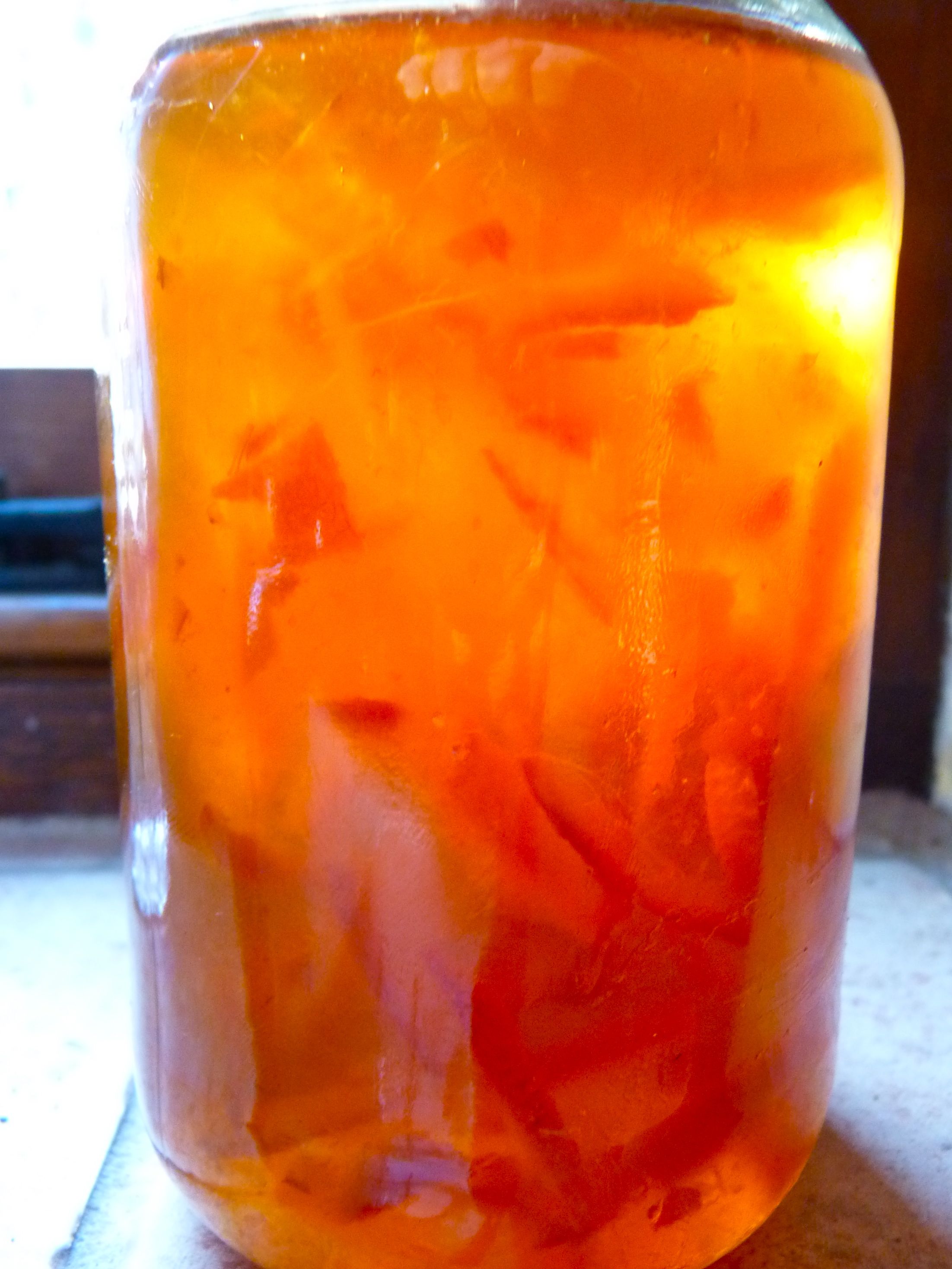
I used Mary Berry’s recipe from The Aga Book. In this recipe she recommends that you simmer fresh fruit for 2 hours and frozen fruit overnight.  This makes me feel better as I missed that instruction and was planning to simmer them for two hours but fell asleep watching telly and went straight to bed having forgotten all about my oranges. You see, things always work out in the end.

This recipe made loads, about 10 jars, so unless you have friends and family who are marmalade fiends too you may want to halve the recipe. You will find another marmalade recipe of mine here.

1½kg (3lb) Seville oranges
Juice of 2 lemons
3 kg (6lb) sugar
2 litres (4 pints) water

Method

Put the whole oranges in the Aga preserving pan and squeeze in the lemon juice. Cover with the water and bring to the boil.  Once boiling, place the pan carefully in the simmering oven and leave to simmer until the oranges are tender (2 hours or so for fresh fruit, overnight for frozen). Remove the oranges and leave to cool. Once cool enough to handle cut them in half and scoop out all the pulp and pips and place these back into the water.  Bring to the boil and boil for 6 minutes.  Strain this liquid into a large bowl through a sieve and, using a spoon, force the pulp through the sieve.  It is this pulp which contains the pectin that will set the marmalade. Pour the liquid back into the preserving pan.

Cut the peel of the oranges as thinly or as thickly as you like your shreds to be and add these to the liquid, along with the sugar.  Bring the whole lot up to a rolling boil and boil until setting point is reached.  You can test for this with a sugar thermometer (105°c) or have a cold saucer ready and when a little is allowed to cool on this saucer it should wrinkle when pushed with your finger.

Allow the marmalade to cool a little (this will help with the distribution of peel through the jar rather than it all sitting at the top) and then pour into sterilised jars.

To sterilise your jars, wash in warm soapy water and rinse with hot water, then place on a baking tray in the simmering oven for twenty minutes.

May 2014: I have been requested to link to Aga Living as this is a recipe from Mary Berry’s Aga Book.

Aga Marmalade Read More »

Shropshire Fidget Pie

Shropshire Fidget Pie is, I have to admit, something I became aware of only a few years ago.  It seems it went out of fashion for some time.  The interest in eating local food has revived its fortunes and I finally got to taste a fidget pie a couple of months ago at our local National Trust property.  The National Trust cafes tend to serve superb local food and this one serves food that is harvested on site from the walled garden and the farm.  Fortunately for me one of the cooks at this property is also a family friend so when I saw her just before Christmas I grilled her for the recipe.  She told me what made up the filling.

Anyway,  as a true Salopian I thought it was about time I made a Fidget Pie.  (For those unaware, a Salopian is someone born in Shropshire.  The county was previously known as Salop, goodness knows why they felt the need to change the name).  Some of you might be aware that I am very proud to be a Salopian and a Midlander so to cook something that hails from the county makes me very pleased.

Our friend’s advice and a search around the internet has led to this version.  It is a combination of several recipes.  At the National Trust they make it in a pasty shape but it is also made like a pork pie in some recipes or as a topped pie as I have in this version.

It was a total success.  Mr OC was a bit dubious when he heard what was in a Fidget Pie, but he was certainly won over tonight. The combination of cider and apples really deliver a tasty punch.  This is a pie that comes highly recommended by me and Mr OC.

Serves 4

For the pastry:

8 oz plain white flour
4 oz cold butter
4 tbsp cold water

For the filling:

1 bramley apple, cored, peeled and sliced
2-3 potatoes, peeled and finely sliced
1 onion, peeled and finely sliced
250g (10oz) ham or gammon
1 tsp brown sugar
salt and pepper
1 tsp dried sage or 4-5 fresh leaves finely chopped
2 tsp cornflour
150 ml (¼ pint) double cream
300ml (½ pint) cider

Beaten egg for brushing over the top of the pie.

Method

Start by making the pastry.  Put the flour and cold butter into a food processor and whizz until it is the consistency of breadcrumbs.  Add the water (you may need more or less) and whizz until it forms a ball.  Put the pastry into a plastic food bag or wrap in clingfilm and place in the fridge for 30 minutes.

For the filling, boil the potatoes for 3 minutes and then add the onions to the water and boil for another 2- 3 minutes.  Drain well.

Using a dish that measures 23cm x 30cm layer the apples, potato, onion and ham into the dish, season with salt and pepper and sprinkle over the brown sugar and the sage.

In a  jug stir together the cornflour and the cream until combined and then mix in the cider.  Pour this over the filling.

Roll out the pastry to the size of the dish and then cover the dish, pressing down well around the sides. Make a hole in the top of the pie. I used my blackbird as a steam vent. Brush with the beaten egg.

Place in a preheated oven at 180°c, gas mark 4 or the baking oven of the Aga for about 1 hour until the pie is golden brown.

The fidget before pastry

My eldest helping with the pastry and egg wash

Shropshire Fidget Pie Read More »

Oxtail stew

I have never before made oxtail stew.  Shocking really.  I tend to buy shin of beef for a stew but I spotted two lovely pieces of oxtail in the butchers on saturday and thought it was about time I tried it. I have always thought that oxtail was a cheap cut, but the butcher says that it is comparatively expensive as it costs about the same price as shin but of course has more waste with the bone. It is also very popular this time of year and the cow only has one tail. So apparently it’s not the cheap option.  However, bones give better flavour and this stew was tasty. It was quite a lot more work than a shin stew though, as the oxtail gives a great deal of fat, almost a mugful in this case.  So you need to make it the day before, chill it, then scrape off the top layer of fat that will have solidified on the surface.  I then chose to take the meat off the bone before reheating to make it easier to eat at the table.  I like to eat a stew with a spoon.

Britain is having a miserable weather week, rain and dull skies so stew is a popular comfort food. This week I read about Wendy’s beef cheek stew, which will be next on my list to try I think.

You probably do need to have a slow cooker or an Aga to make this stew as it needs about 8 hours  simmering away and this may be costly in a normal oven.

This is a general guide, put more or less in as you feel and you could add potatoes or pulses to make it even more substantial.

Serves 4

1kg of oxtail, separated into pieces (they can come tied in a bundle)
2 onions, sliced
5 sticks of celery, sliced
4 carrots, sliced
50g (2oz) flour
50ml madeira or sherry
900 ml (1½ pints) of good beef stock
2 bay leaves
1 tsp dried mixed herbs, or a bundle of fresh herbs if you have them to make a bouquet garni
salt and pepper

Method
Brown the meat well in a large casserole dish that is suitable for the hob and the oven, otherwise do the browning and cooking in a frying pan and then transfer it all to a casserole dish that is suitable for the oven or into a slow cooker. It is unlikely that you will need oil as the oxtail will release plenty of its own fat. Remove the meat to a plate. Add the vegetables to the pan  and cook until the onions are translucent and the carrot and celery are tender. Add the flour and stir well and cook for a minute or so.  Add the madeira or sherry and mix well and then gradually add the stock, stirring to make sure the flour is well combined into the gravy.  Add the meat back into the casserole dish, with any juices that may have gathered on the plate.  Add the herbs and season generously.  Bring to a gentle simmer and then place in a low oven (the simmering oven of the Aga) or into a slow cooker for about eight hours.  Remove from the heat and allow to cool before placing in the fridge overnight.  Skim off all the solidified fat and, if you wish, remove the meat from the bones.  Reheat the stew at a gentle pace until piping hot.  Serve in large warmed bowls with lots of bread.

Oxtail stew Read More »

Ham and vegetable bake

It has been ages since I shared something savoury with you.  It’s not because we eat cake and nothing else in this house, it’s because my savoury food is never very photogenic.  I would like it to look like this or this but it never does.  My presentation skills are always lacking.  I never pile things into towers I just spoon it onto a warmed plate. It is especially difficult to get a good photo of an evening meal in an English winter.  With a cake I can take it outside and take a photo using the little natural light offered by our dull January days.  With an evening meal the sun was last seen a good few hours ago and the lights in our kitchen are of the spot variety which means wherever I stand I am always casting a shadow.

Anyway, I decided that last night’s meal was so good it needed to be shared with you regardless of whether it looks a bit of a mess in the photos. I had roasted a gammon joint, but I should have boiled it or soaked it the previous day because it’s just a bit too salty . So I thought if I layered it into a potatoes boulangere this might reduce the ham’s saltiness but add a good flavour to the potatoes.  Then I thought I might add carrots too to add an extra savoury element.

The end result was very comforting indeed, soft and squidgy veg and tender ham with a crispy potato topping.  I urge you to try it soon. If I had more time I would have crisped the top more, but we were both very hungry.

Serves 2 hungry people

2 large potatoes, sliced thinly
2 carrots, sliced
1 onion sliced thinly
4 ham slices
400ml vegetable or chicken stock
pepper
butter

Method
I use a tin measuring 26cm x 20cm and butter it generously.  Then place a layer of potato, a layer of carrot, a layer of ham, then a layer of onion in  the tin and season generously with pepper (you won’t need any salt).  Top with a layer of potato and pour over the stock.  Dot with more butter.  Cover with foil and bake in a preheated oven at 180°, gas mark 4 or the baking oven of the Aga for 1½ hours.  Remove the foil and continue to cook for another ½ hour until browned on top. Serve in a pile on a plate if you are anything like me.  A chunk of good bread is obligatory to soak up the juices.

Here it is before the final layer of potato.

Ham and vegetable bake Read More »

Lemon meringue

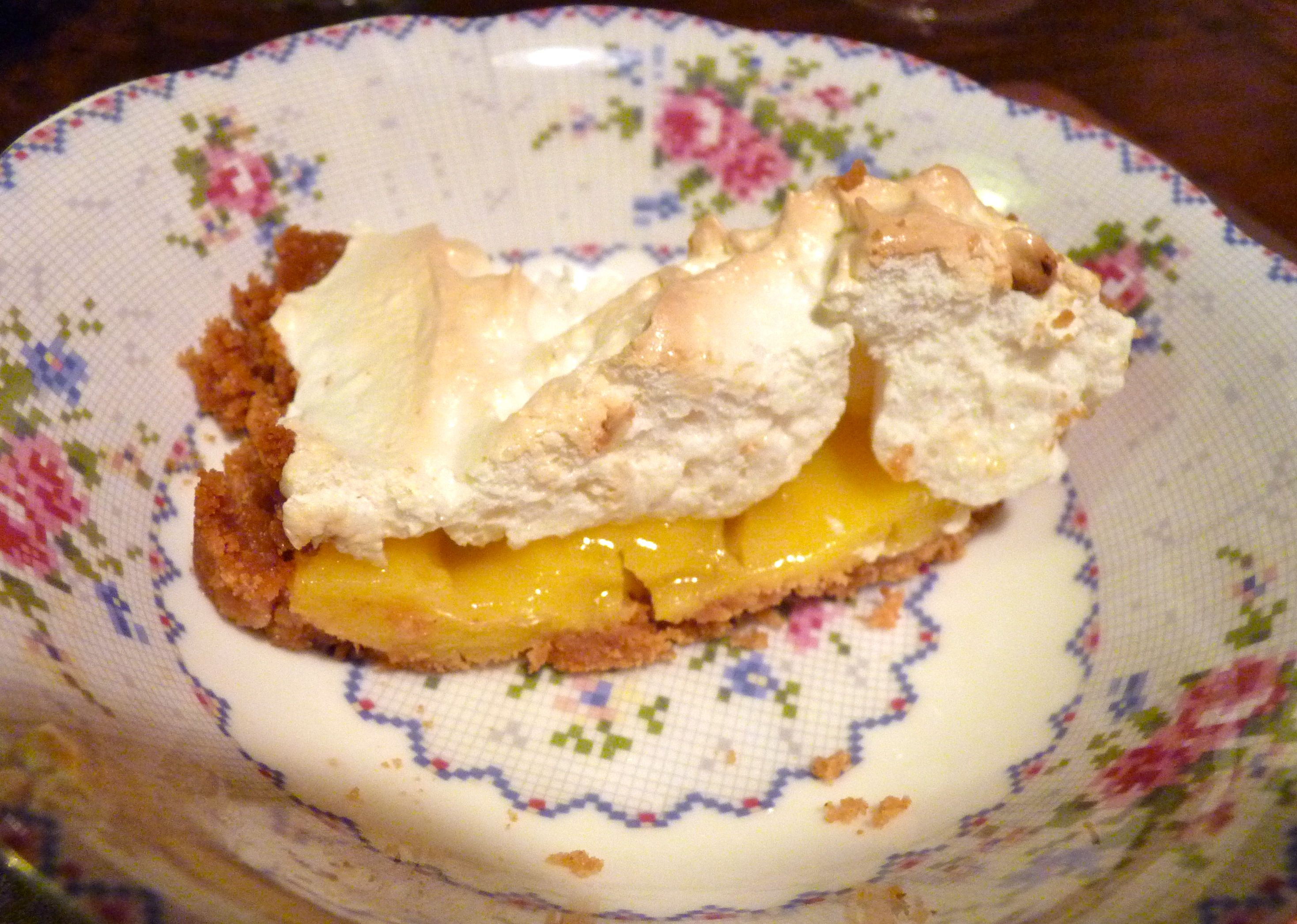
First, I apologise for the poor quality of this photo.  It was after Sunday dinner and I was serving nine people a choice of either baked apples or lemon meringue ( or both if you are Mr OC) and they were anxious to dig in.  I felt bad delaying them whilst I tried to get a decent shot.  So I gave up and took this one. It doesn’t do the pie justice at all.  A lemon meringue is a thing of beauty, a crumbly biscuit base, tangy lemon filling and pillowy meringue – heaven.

I always use Mary Berry’s recipe from her The Aga Book (published by Aga Rayburn) as it is completely fail-safe and makes a very good pie indeed. You can make a biscuit base  or you can do a sweet pastry base.  Both are good but I think biscuit may just have the slight advantage so this is the one I tell you about here. Now, because I always make this in my Aga I am going to concentrate on telling you this method and then tell you how Delia Smith cooks hers so that you can use this information for whatever oven you have.

These instructions are for a 23cm loose base metal flan tin

Biscuit base:

175g (6oz) digestive biscuits
50g (2oz) butter, softened
Mary Berry adds 45g (1½ oz) demerara sugar but I don’t think this is necessary so I omit it.

For the filling:

2 large or 3 small lemons
40g (1 ½ oz) cornflour
300ml (½ pint) water
3 egg yolks
75g (3oz) caster sugar

For the meringue:

3 egg whites
120g (4½ oz) caster sugar

Method

For the biscuit base, place the biscuits in a food processor and whizz to crumbs. Add the softened butter and whizz again until combined.  If you don’t have a food processor, then place the biscuits into a large plastic food bag and bash with a rolling pin (or similarly heavy implement) until crumbs.  Place the crumbs into a bowl.  Melt the butter and add to the crumbs and mix well.

Place the crumb mixture into the flan dish and press down with the back of a spoon until   it covers the base evenly and goes slightly up the sides of the tin. Place the tin onto a baking sheet and place in the roasting oven of the Aga, or into a preheated oven at 200°c, gas mark 6, for 6 minutes until lightly browned. Leave to one side whilst you make the filling.

For the filling:

Pour the water into a pan and bring to the boil.  Place the finely grated zest and the juice of the lemons into a bowl and add the cornflour and stir to blend. Pour in the boiling water and mix well, then return the mixture back to the pan and heat until the mixture thickens. Mix the egg yolks and sugar together in a bowl and then add to the cornflour mixture and stir on the heat allowing it to bubble a few times.  Take the pan off the heat and allow to cool a little before pouring evenly over the biscuit base.

To make the meringue:

Beat the egg whites until forming stiff peaks and then add the sugar one spoonful at a time beating well after each addition.  You should have a thick glossy mixture when finished.  Spoon this over the top of the filling making little peaks, which will brown nicely and become crunchy, contrasting with the soft meringue underneath.

For the Aga, place the pie (still on the baking sheet) on the grid shelf positioned on the third set of runners of the roasting oven for 2-3 minutes until gently golden.  Transfer to the simmering oven for a further 15 minutes.  You can serve it warm or cold, it’s delicious either way.

For an ordinary oven Delia recommends preheating the oven to 150°c, gas mark two and cooking at this temperature for 45 minutes.

Lemon meringue Read More »