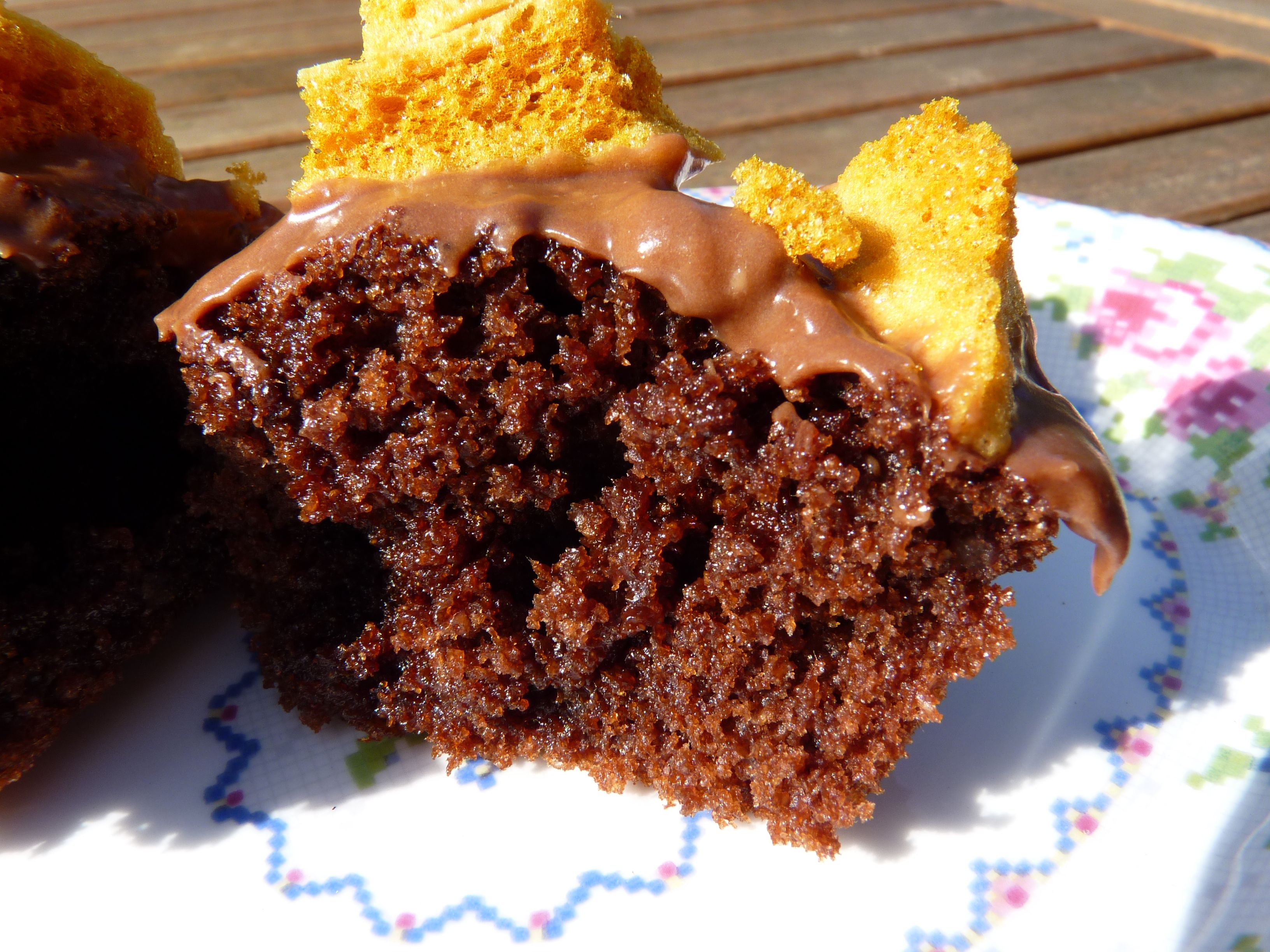
Honeycomb chocolate cupcakes

This is my contribution to this month’s We Should Cocoa Challenge.  This month it is very exciting as the challenge is a year old (time flies!) and Chele wanted everyone to make a cake suitable for a first birthday.

My cupcakes are inspired by the wonderful blogs of both Chele and Choclette, the brilliant bloggers behind We Should Cocoa.  They have both recently featured honeycomb – Chele made Nigella’s Hokey Pokey and Choclette reviewed some very delicious looking honeycomb draped in Valrhona (drooling!).  I knew I had to make some honeycomb and soon.  Then I thought about a cupcake featuring honeycomb. When I was making them it seemed obvious that I needed to use spelt flour as I learned about spelt flour from Choclette.  The spelt flour has the consistency of wholemeal and so adds a bit more texture to the cupcake.  I happen to like this, but if you prefer yours in the traditional style then by all means use plain flour.

And, of course, if you are only one year old you don’t want a great big slab of cake (or you may want a big slab but your mummy won’t let you), so a cupcake is perfect.

Thanks to Chele and Choclette for a fabulous monthly challenge which has inspired me many times during the last year.

Before I divulge the recipe I have a few confessions to make.  I cooked the cupcakes with honeycomb sprinkled inside the batter, but all it did was dissolve and escape out of the top of the cakes so I wouldn’t bother with doing that again. My instructions for making the cupcakes will leave this bit out.  Also, when I was making the hokey pokey I reduced the amount of bicarb from the original recipe from 1½tsps to 1 tsp.

To make the cakes, first make the hokey pokey as described by Chele. Then make the cupcake batter as follows.

110g caster sugar
110g softened butter (unsalted)
pinch of salt
2 eggs
20g cocoa powder
1 heaped tsp instant coffee powder
100ml hot water
140g flour (spelt or plain)
1 tsp baking powder

Method
Dissolve the cocoa powder and the instant coffee in the hot water and allow to cool. Place all the ingredients into a large bowl and whisk until well combined.  Spoon into cupcake cases and bake in a preheated oven at 180°c, gas mark 4 or in the baking oven of the Aga for 12-15 minutes until cooked.  When you place a fingertip on top the cake should spring back. Remove the cakes in their cases to a wire rack to cool.

Make this chocolate frosting and top with honeycomb.  Make a cup of tea and enjoy.


Honeycomb chocolate cupcakes Read More »

Sausage and borlotti casserole

Autumn it seems has arrived.

With autumn comes the renewed need to eat warming stews and casseroles. Hooray for autumn.

When I was wandering around Ludlow Food Festival last week I spotted some very delicious looking venison, port and thyme sausages at the Legges of Bromyard stand. I couldn’t resist.  Then it occurred to me that in about an hour’s time I was going to eating quite a few sausages and they might not be the best thing to take home for my tea this particular evening.  So, as I walked out of the castle grounds and through the thronging crowds of the Castle Square I walked past an empty butchers shop ( I hope they had a very busy stall somewhere within the festival grounds).  I popped in for a hefty piece of rump for tea that particular night and saved my sausages for the next night. What a treat they were too.

We have some borlotti beans in the garden.  I had bought some Wenlock Edge Farm baked ham from the festival ready for the fidget pie I was going to be baking the next day and there is ALWAYS a bottle of red wine sitting by the Aga (it’s a very bad day if there isn’t). This was the result, served with a steaming pile of mash.  Hooray for autumn indeed.

Serves 2 hungry people

4 good quality sausages, venison if you can get them
2 onions, peeled and finely chopped
½ dsp juniper berries (I used 1 dessertspoon but it was a little too overwhelming), lightly crushed
2-3 sprigs of fresh thyme or 1 scant tsp dried thyme
300g fresh tomato chopped, or you could use a 400g can
100g ham or bacon diced
2 bay leaves
250g borlotti beans, fresh or canned
1 tbsp tomato puree
300ml red wine

Method

If you are using fresh borlotti beans then boil them in plenty of water until tender (10-15 minutes), then drain.

Brown the sausages in a little oil in a pan and remove to a plate.  Add the onion to the fat in the pan and fry until translucent and just beginning to tinge golden. Add the ham or the bacon and fry for a minute or two. Return the sausages back to the pan and add the juniper berries, thyme, bay leaves and borlotti beans. Add the wine and let it bubble for a minute or two.  Stir in the tomatoes and the tomato puree.  Season with pepper (you probably won’t need salt with the bacon and sausages, but taste at the end and add then if you do need it).  Bring everything to a simmer and cook slowly for about 40 minutes. If you want a thicker sauce, mix 2 tsp cornflour with a little water in a cup and then pour into the casserole and stir in well.  Allow to simmer for another five minutes before serving. Serve with mashed potato or cabbage.

PS I can’t claim credit for the leaf shot, that is Mr OC doing the fancy things he does with that camera of his.


Sausage and borlotti casserole Read More »

Judging those sausages at Ludlow

Firstly, I must apologise for this post taking a week to write. My eldest was seven at the weekend (where did those seven years run off to?) and so last week was a frenzy of tidying, planning, buying and cooking.  (Note to self: next year convince her that a party at the ball pit or ice rink is a much better idea than a party in the garden).

Anyway, the Ludlow Food Festival was brilliant this year.  I had my best year yet there, wandering around finding all the brilliant local producers, trying and buying their wares.  I also met up with Jo and Louise from Midland Food Bloggers.  It was lovely to meet them and have a chat and a wander.

Then at 3pm the main event for me was being part of the judging team for the Expert’s Choice for the best sausage of the five sausages on this year’s Sausage Trail.  The judging panel this year was myself, The Sausage King and his very adorable young son The Sausage Prince (who of course was the best judge at the table – that kid knows his sausages) and Rosanna Taylor-Smith, Councillor for Ludlow North.

Every year, as part of the festival, there is a sausage trail, with two rounds of judging.  The Peoples’ Choice Award and the Expert’s Choice Award.  For the first festival-goers buy a Sausage Trail Leaflet and then set off to try a bit of each of the sausages.  (It is extremely popular and the queues at each sausage stand are a sight to behold.) They then award each sausage a score, decide which one is best, take their leaflet to the final sausage tent and swap their completed leaflet for their favourite sausage in a bun. All of these leaflets are sorted and the sausage with the most votes becomes the People’s Choice.  Then a panel gets to try all five sausages and decided which sausage should win the Expert’s Choice.  This is the second year I have been on this panel and the judging is great fun, if not just a little bit difficult because of the very high standard.

All five butchers are local to Ludlow and the surrounding area and all five are traditional butchers producing some excellent quality meat. The sausages were all of a very high standard and all tasted mighty fine.  However, for the expert panel there were two sausages which came very close to being the best.  We all tasted and then tasted again, and then tasted again.  But in the end we all came to the same conclusion, the sausage from D W Walls just about clinched it, with Griffiths’ sausage coming a very close second.

The People Choice Award also went to Walls, with the Ludlow Food centre coming a very close second in that competition.

The entries this year were:

Andrew Francis Butchers – Pork with cracked black pepper
A. H Griffiths Butchers – Pork with sundried tomatoes and mushrooms
Legges of Bromyard – Pork with smoked pancetta and rocket
Ludlow Food Centre – Pork with blue cheese, redcurrant jelly and port
D W Wall – Pork with camembert, chives and redcurrant jelly

I do hope I can do it all again next year.

Judging those sausages at Ludlow Read More »

BBC Radio Shropshire’s Fidget Pie

It has been another exciting day!  I have become a radio star (well ok, not quite, but nearly…).

BBC Radio Shropshire, my local radio station, have tasked themselves with making an entirely Shropshire Fidget Pie.  The Fidget Pie, as regular readers may remember, is a traditional pie of Shropshire.  The name is reputed to come from Fitcheted, meaning five sided (so presumably it used to be made five sided), or alternatively from being carried about in the pockets of farm workers and the filling fidgeting about.  Either way, I was captivated by its deliciousness when I discovered it and you can read my original post about it here.

In the BBC Radio Shropshire’s quest to make an entirely Shropshire Fidget Pie they came across that particular blog entry and decided that my pie deserves the status of the ultimate fidget pie (look away quickly, I am blushing).  I am extremely proud of this – I love food and I love Shropshire and in the Fidget Pie these two things are combined.

Their mission is to find the ingredients of everything in the fidget pie in Shropshire, including the pie dish.  They admit that it might be difficult to find salt and pepper, in which case an alternative will be sought.  But Shropshire is a farming county and we have some wonderful producers.  I, for one, am looking forward to following them in their mission to source everything locally.  Their promotion of local food is wonderful and the concept of creating an entirely Shropshire Fidget Pie is an exciting one.

Vicki Archer,one of the co-presenters of the Drive programme, came to my house to interview me and try my Fidget Pie and the results of that interview can be heard for the next seven days here. If you do want to listen, the interview starts 43 minutes into the show and is in three segments, the last starts about 1 hour and 10 minutes into the show.

I am ridiculously pleased to be on the radio talking about something I love.  I will be going along to the final tastings of the entirely Shropshire Fidget Pie in a few weeks and will let you know how that goes.


BBC Radio Shropshire’s Fidget Pie Read More »

Individual Apple Pies

I was picking up my youngest daughter from school (she started last week and is enjoying it so far, fingers firmly crossed that it stays this way) and there next to the door I fetch her from is a magnificent apple tree with lots lying on the floor.  I couldn’t resist.  I chose the best two I could find and came home and made these.

They don’t look like Mr Kiplings’ but that is part of their appeal.  They are very easy to make and require little dexterity – always a bonus.

200g plain (all purpose) flour
100g cold butter, diced
cold water to mix

about 3oog cooking apple, peeled, cored and sliced thinly (I used 2 medium sized apples)
demerara sugar (or other sugar would work just as well, I just like the crunch of demerara)

Method

Make the pastry by placing the flour and the butter in a food processor and pulsing until it resembles breadcrumbs.  Add enough cold water to mix (I find a small wine glass of water, so about 125ml, is normally about the right amount, but add gradually).  Pulse until the pastry just begins to come together.  If you don’t have a food processor then place the flour into a large bowl, add the butter and using the tips of your fingers rub the butter into the flour until it resembles breadcrumbs. Add the water and mix with a palette knife until it begins to come together.

Form the pastry into a ball and flatten slightly.  Wrap in clingfilm  and place in the fridge for 30 minutes.

I used a muffin tin for my individual pies.  Roll out the pastry and then cut out circles measuring 11.5cm – this is the size of my espresso saucers and so I used these to cut round with a sharp knife. I managed to get nine circles out of my pastry.  Push the discs into the holes of the muffin tin, using your fingers to carefully push the pastry to the bottom and up the sides.  This leaves some pastry overlapping the top.  Fill the pastry with apple slices and sprinkle a teaspoon of sugar over each.  You could also sprinkle cinnamon if you wanted to. Then wrap the overlapping pastry over the top of the apple.

Sprinkle a little more sugar over the top and place in a preheated oven at 200°c, gas mark 6 or in the Roasting Oven of the Aga for 15-20 minutes until golden brown.

This was a very satisfying way of using a couple of apples that would have rotted otherwise and the girls enjoyed them.

Individual Apple Pies Read More »

Judging Sausages at Ludlow

It’s going to be a busy and exciting weekend.  It’s Ludlow Food Festival weekend – a major highlight of the foodie year – and this will be the second time I am going to be a sausage judge for the Expert’s Choice and helping to decide which sausage should take the top accolade this year (banish all thoughts relating to either Julian Clary or Frankie Howerd immediately!).  It was great fun last year and so I very much expect it to be the same this year. I am looking forward to meeting The Sausage King this year, as last year circumstances meant he couldn’t be there to proffer his knowledge of all things sausage. You can see how I got on last year as a judge in this post.

Whilst I am there I am taking the opportunity to meet up with other fellow Midland Food Bloggers, including Louise of Comida y Vida and Jo from Jo’s Kitchen. I am really looking forward to what should be a great day out.  I will let you know next week how the sausage judging went and what the highlights of this year’s festival were for me.

Judging Sausages at Ludlow Read More »

Pickled peaches

My mum and dad have a peach tree in their garden and because we live in Shropshire and not Spain they are much smaller than the peaches that you buy.  You have to pick them before the grey squirrels find them and then leave them to ripen in the fruit bowl.  This year there has been plenty on the tree and I commandeered them to try out this way of preserving them for the winter months.

They were fiddly little blighters to peel, but they are very lovely with their pink blushing cheeks.
 Once made you need to leave them for a month before eating to give the flavours a chance to mellow and pickle away. So I am looking forward to enjoying these with a slice of ham in October and I will definitely  be saving some for Christmas.

Makes 4-5 jars

1.5kg peaches
500ml white wine vinegar (or cider vinegar)
600g granulated sugar
25g root ginger (I used about 1 teaspoon from my jar of Lazy Ginger)
8 whole cloves
cinnamon stick
½ tsp coriander seeds
¼ tsp dried chilli flakes

Method

Plunge the peaches into a large pan of boiling water for one minute, drain and then cover with cold water.  Peel the peaches and place in a bowl (I did this in the morning and then pickled the peaches in the afternoon and was surprised at how much blush coloured juice collected in the bowl.  Make sure you pour these juices into the vinegar with the peaches).

Pour the vinegar into a preserving pan, add the sugar, the ginger and the spices and stir over a gentle heat until the sugar has completely dissolved. Bring to the boil, add the peaches and any juice collected in the bowl and turn the heat down to simmer.  Simmer until the peaches are tender, which depending on the ripeness of the peaches will take anywhere from 3-8 minutes.  Spoon the peaches into warm, sterile jars.  Return the syrup to the heat and bring to a boil and allow to boil for 5 minutes.  Carefully pour the syrup over the peaches to the top of the jars and seal with vinegar proof lids.  Leave for one month before trying.

Pickled peaches Read More »

Damson or Plum Jam

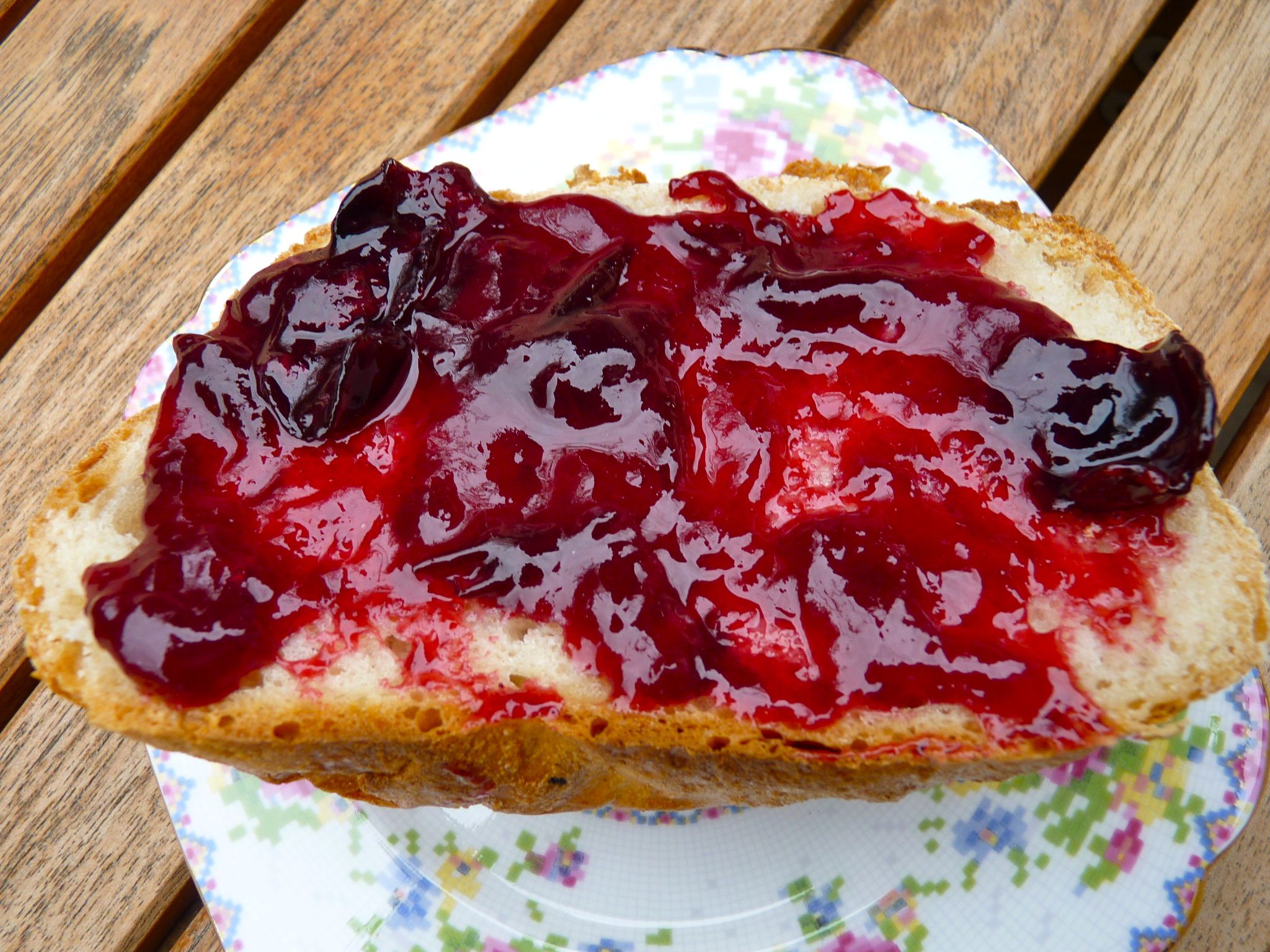
Damson jam is a big favourite in this house.  I love it and my youngest adores it too.  We are lucky enough to have a couple of damson trees in the garden and they produce well most years.  I usually make something with them before freezing some for that lovely winter treat stewed damsons.  Sometimes I will make pickled damsons, otherwise damson vodka (very popular round here for some reason) or damson jam and if I am feeling especially productive I will manage all three.  This week is the turn of the jam. It is very easy to make and very delicious to eat. The same recipe can be used for plums of any description.

This makes about 6-7 jars of varying sizes or 8 lb jars

1.5kg damsons
1.25kg granulated sugar
400ml water

Method

I can never be faffed to stone my damsons before making this jam and so I cook them whole and then scoop most of the stones out before pouring into the jars and then take the rest out when spreading on my  bread. But if you have more patience than I do then go ahead and stone the damsons/plums.

Put the prepared damsons/ plums (i.e stems removed, any over ripe ones removed, washed) into a preserving pan with the water.  Simmer for about ten minutes until the fruit is soft. It may take longer for some varieties and some may be ready sooner so keep an eye on things.

Add the sugar and stir until dissolved.  Bring to boiling point and boil rapidly until setting point is achieved.  Setting point can be tested by placing 4 saucers in the fridge before you start making the jam and then you pour a teaspoonful of the jam onto a cold saucer.  Leave to cool for a minute or so and then push the jam with your finger, if it wrinkles, it is at setting point. If it doesn’t wrinkle then boil for a few more minutes and then test again.  Otherwise use a jam thermometer and it is ready when it reaches 104.5°c.

Remove any scum that has risen to the surface. Pot into sterilised jars and cover whilst hot.


Damson or Plum Jam Read More »

Madeiran Custard Tarts – Pasteis de Nata

These custard tarts are very Portuguese ( Madeira is a Portuguese Island) and very delicious.  They put the English custard tart to shame with their egginess and deliciousness.  The many bakeries in Madeira are the best place to buy them, should you find yourself on the island any time soon. The tarts available in the supermarkets (Pingo Doce and SA) are just not as good. But if you find a good bakery then these little treats are divine – crusty flaky pastry filled to the brim with sweet unctuous egg custard and caramelised on top.

I was determined to have a go when I got home so I searched blog sites and YouTube and found this video.  I watched it, tried my best to translate it, and then halved the mixture (because even I can’t eat 24).  I then had a go on Monday afternoon, trying to memorise what she did.  Needless to say I got it wrong.  I forgot the boiling the sugar part and just added the sugar to the milk.  I also didn’t note that she was just using the egg yolks and so I added the whole eggs.  The result tasted pretty good but it wasn’t the same as I had when in Madeira.  So today I watched the video again, took more note of what she is actually doing and then made them again. I am pretty pleased with the result.

I used a lot more pastry than the lady in the video does but then I am a big pastry fan.  You may want to be more light handed with your pastry than I am and make the bases a little thinner.

500g puff pastry or Delia’s Quick Flaky Pastry (recipe below)
250ml milk
A good sized strip of lemon peel (removed using my vegetable peeler)
1 cinnamon stick
30g plain (all purpose) flour
250g sugar
125ml water
4 egg yolks

Method

Place the flour in a small bowl and use about 50ml of the milk to make a smooth paste.  Pour the rest of the milk into a saucepan, add the lemon peel and cinnamon and heat to boiling point.

In the meantime, pour the sugar into another saucepan and add the water.  Place over a gentle heat and stir until the sugar has dissolved.  Stop stirring, turn up the heat, bring to the boil and let it boil for three minutes.

When the milk has come to the boil stir in the flour and milk paste and using a whisk keep whisking until smooth.  Cook for a minute or two, stirring all the time, to cook out the flour.  Once the sugar syrup has boiled for three minutes, carefully (because it will be very hot) and gradually add the sugar syrup to the milk mixture, whisking all the time.  When it has all been added allow to boil for a minute.  Then strain the mixture through a sieve to remove the lemon peel and cinnamon stick.  Allow to cool whilst you put the pastry into a muffin tin.

If you are using ready made puff pastry roll it out into a rectangle and then roll up into swiss roll shape and slice into 12 even sized pieces.  If you are making Delia’s Quick Flaky pastry then form into a long sausage before chilling.

Take each piece and mould, using your thumb and fingers, into the hole of a muffin tray ( if you watch the video you will see what I mean).

Now add the egg yolks to the custard mixture and whisk in well. Make sure that the custard mixture is not still hot or the egg yolks will scramble. Pour this mixture into the pastry moulds and cook in a preheated oven at 250°c for about 15-20 minutes.   (I cooked mine in my Aga which does not reach 250°c, so I cooked them on the floor of the roasting oven for ten minutes to cook the base of the pastry cases, then moved to near the top of the roasting oven for another fifteen minutes before they were cooked to my liking and nicely caramelised on top.)

For Delia’s Quick Flaky Pastry:

When I made these tarts on Monday I followed Delia’s recipe word for word but the pastry only stretched to fill nine muffin holes so I made 1½ times the mixture today which yields nearly 700g of pastry.  This is more than enough for 12 and a bit left over for jam tarts or cheese straws depending on how the fancy takes me later.

350g plain flour
250g butter
pinch of salt (if you are using unsalted butter)
cold water to mix ( I probably used about 1 large wine glass full)

Method

Place the butter in the freezer for 30 minutes.

Put the flour and salt in a bowl. Grate the butter over the flour and mix with a palette knife.  Add water and continue to mix with the knife until it starts to come together.  Then quickly use your hands to bring it into a sausage shape.  Wrap in clingfilm or a food bag and chill in the fridge for thirty minutes.  The key is to handle it with your warm hands as little as possible to keep it flaky.  When you are ready, take golf ball size pieces of pastry and mould into the muffin holes.


Madeiran Custard Tarts – Pasteis de Nata Read More »

Sausage, chard and borlotti beans

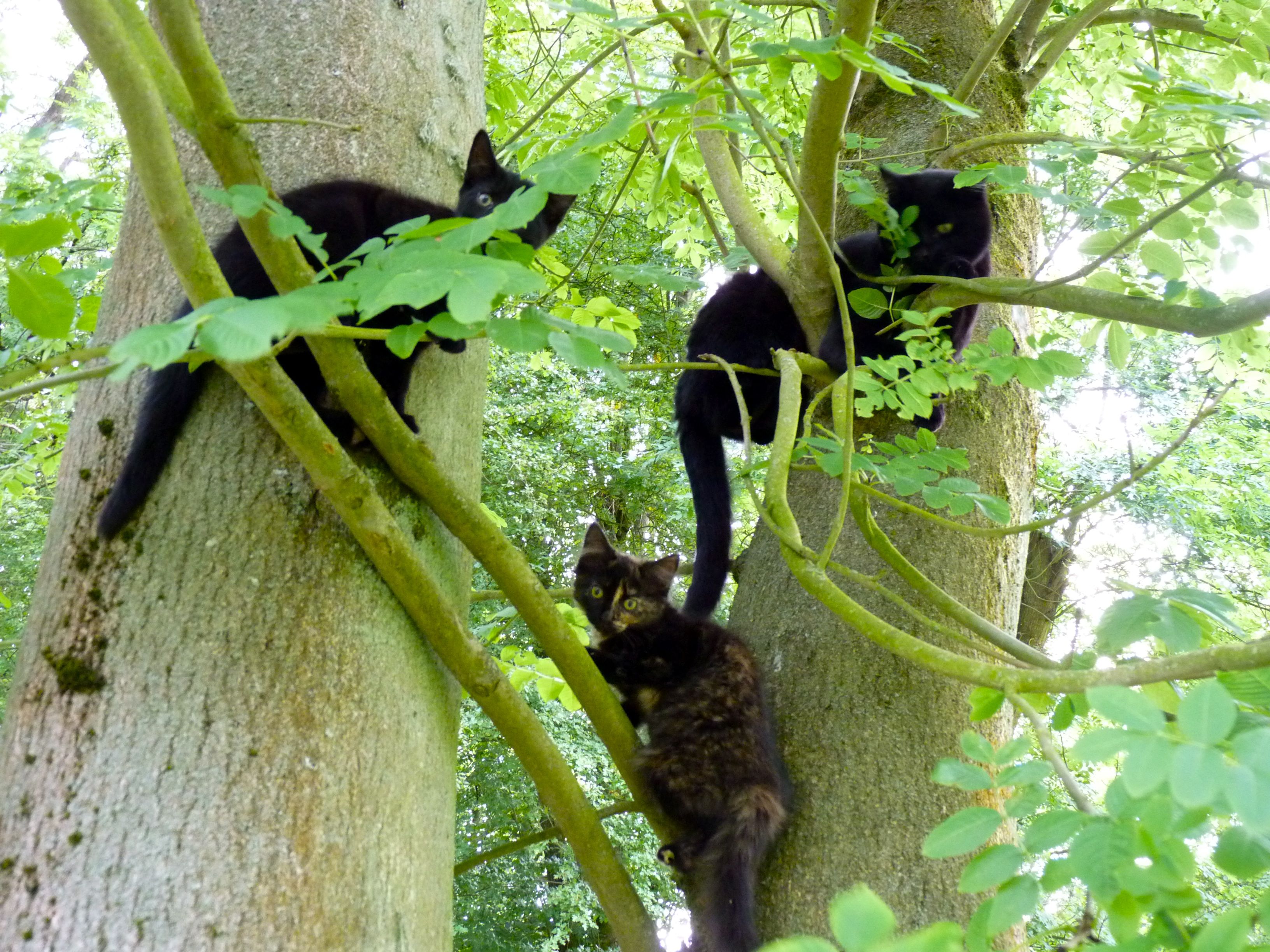
We have just come back from a two-week holiday in Madeira.  It was very warm, relaxing and enjoyable.  It is lovely to get away but I think it is even better to come home. We always look forward to getting back to the pets, including these three, who we missed a lot. The big lad is Merlin (what else could he be called?), the black kitten is Wobble and the tortoiseshell is Wibble.

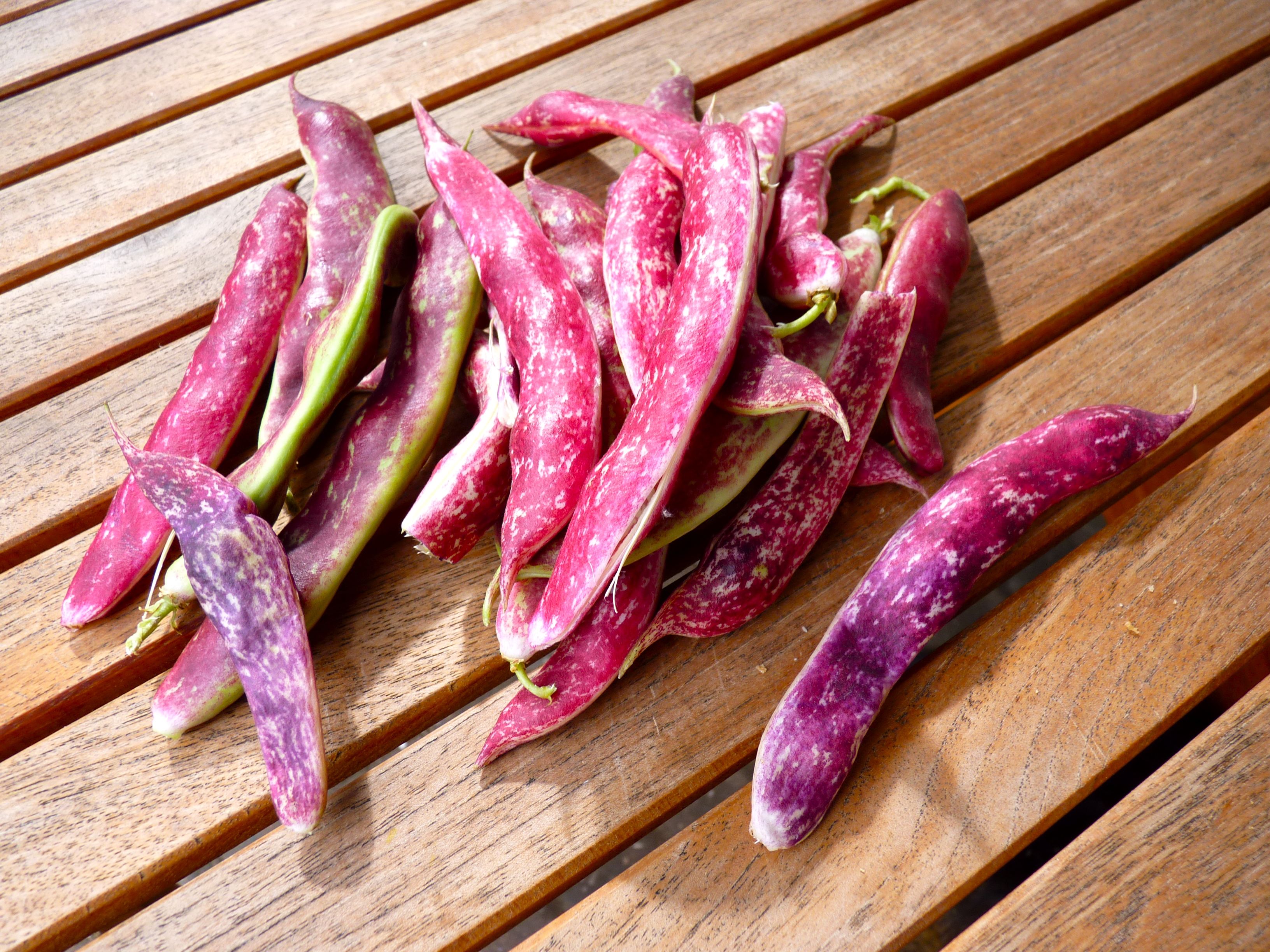
The other lovely thing to come back to is the garden.  It is amazing how much things grow in two weeks. The borlotti beans have really begun to shine with masses of beautiful speckled pods hidden amongst the pale leaves.

They really are very beautiful.

The chard is a good size ( at last, it seemed to be forever germinating).  The runner beans are still coming, thanks to mum and dad picking them regularly whilst we were away.  A few tomatoes have begun to ripen, they seem very slow this year, but in contrast the damsons have begun to fall from the tree – that is the earliest we can ever remember that happening. The patty pan squash are beginning to be prolific and the cucumber is bearing some fruit too. The chillies are taking over and I may go into the greenhouse one day and never be able to get out again!

I spent an enjoyable half hour last night picking and shelling the borlotti, preparing some of the red, gold and white chard (this is the first time we have grown it and we will definitely grow it again) and discovering the treasures that can be unearthed in the potato patch.  The latter include some gorgeous purple potatoes that my dear blogger friend Choclette sent me about two years ago.  They are a heritage breed originally from Peru and whilst they really do make a marvellous mash they were also very delicious as part of last night’s tea along with some Anyas which self set from last year’s plants.

I added some sausages from the local butcher and Bob’s your uncle a delicious dinner that celebrates a much missed garden.

 This is a dish which is very adaptable, if you don’t have potatoes use some pasta, if you don’t have chard then use cabbage, or green beans or runner beans.  I cooked the borlotti in water with a sprig of rosemary and a clove of garlic (still in its paper) for about ten minutes until tender.  I cooked the sausages in a casserole dish so that the juices gather and crust at the bottom of the dish.  I boiled the potatoes until tender.  I diced the chard stems into 1 cm chunks and cooked with a large knob of butter with a squeeze of lemon juice and salt and pepper until nearly tender, then threw in the sliced leaves for a few minutes more cooking until nicely wilted.  I added about five sage leaves, roughly chopped, to the sausages, then tipped in the beans, potatoes and chard (with all the lovely buttery juices) and cooked until everything is hot and covered in the juices. I then served with crusty bread and a vinaigrette. Lovely!


Sausage, chard and borlotti beans Read More »